Amazon Extends Prime Big Deal Days Deal Submission Deadline to September 22
Sellers get additional time to submit promotions, prepare FBA inventory, clear aging stock and build advertising momentum ahead of Amazon’s major fall shopping event
By ChannelMAX Staff Writer
Sept-2026#04
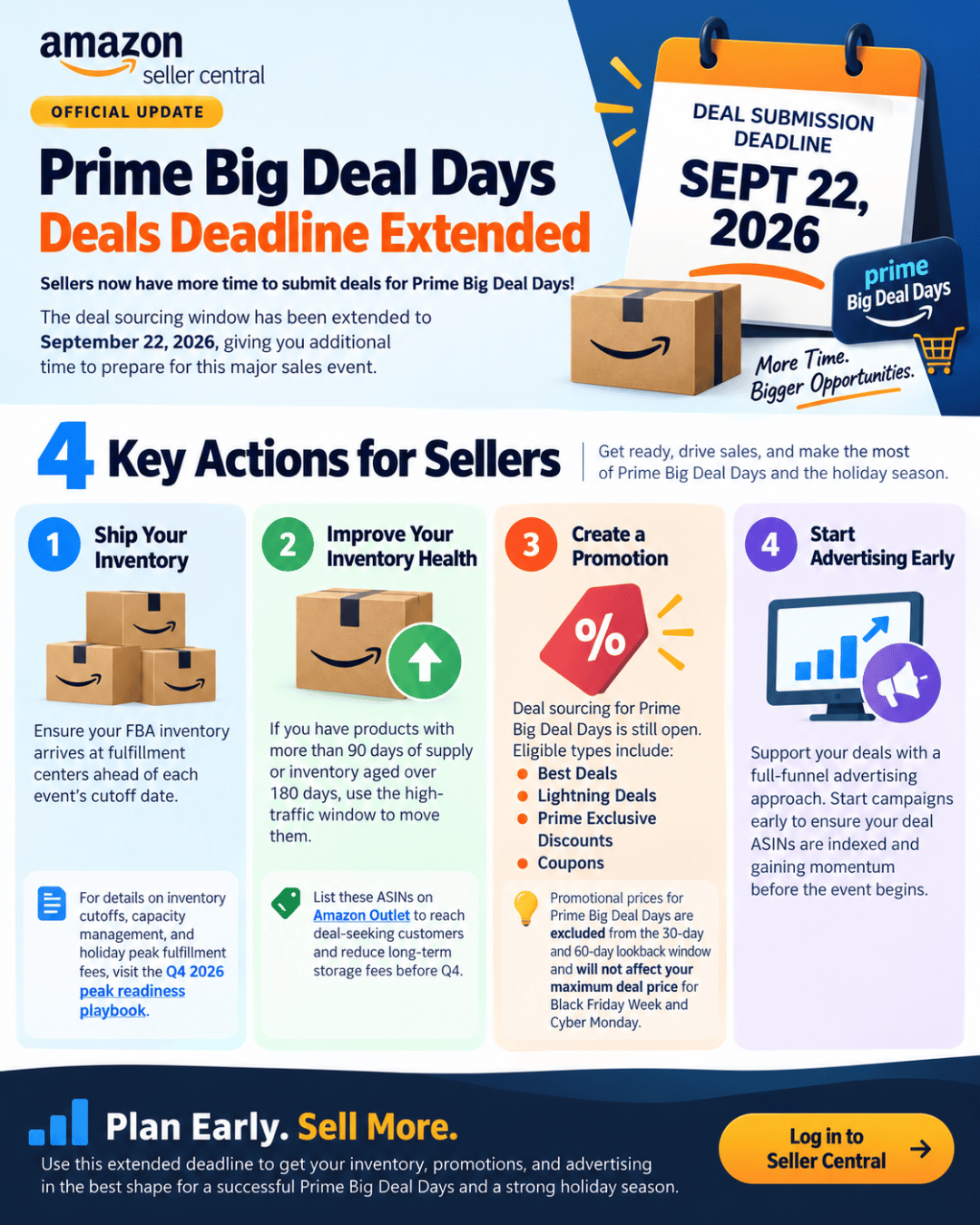
Amazon sellers preparing for the 2026 holiday shopping season have received more time to finalize their promotional strategy for Prime Big Deal Days. The deal sourcing window has been extended through September 22, 2026, providing eligible sellers with additional time to submit deals and prepare inventory for the high-traffic event.
The extension was disclosed in an official update posted on Amazon Seller Central on September 8. Amazon is encouraging sellers to use the extra time not only to create promotions but also to review FBA inventory, improve inventory health and begin advertising campaigns before the event.
Deal Sourcing Now Open Through September 22
The September 22 deadline gives sellers who have not yet completed their Prime Big Deal Days promotions another opportunity to participate.
According to the Seller Central announcement, eligible promotional formats include Best Deals, Lightning Deals, Prime Exclusive Discounts and coupons. Sellers should check their individual Seller Central accounts because deal eligibility, recommended products, pricing requirements and available promotion types can vary by ASIN and account.
For sellers, the extension is particularly useful if they need more time to determine which products can support deeper discounts while remaining profitable. Rather than selecting products solely on sales volume, sellers should consider margins, inventory levels, advertising costs and expected demand before committing to a promotion.
Also Read: Amazon Seller Assistant Now Explains Why Your Offer Isn’t the Featured Offer
Prime Big Deal Days Pricing Gets an Important Q4 Advantage
One of the most significant points in Amazon’s announcement concerns promotional pricing.
Amazon said Prime Big Deal Days promotional prices will be excluded from the 30-day and 60-day lookback window used for determining the maximum deal price for Black Friday Week and Cyber Monday promotions.
This gives sellers greater flexibility when planning promotions across multiple Q4 events.
A seller may be able to offer an aggressive Prime Big Deal Days price without that promotional price negatively affecting the maximum deal price required for eligible Black Friday Week and Cyber Monday deals later in the season.
This distinction is important because sellers often need to balance short-term conversion gains against future promotional eligibility. Amazon’s clarification gives sellers more room to treat Prime Big Deal Days as a separate promotional opportunity while continuing to plan for the November shopping period.
Sellers Should Move FBA Inventory Early
Submitting a deal is only part of the preparation. Sellers using Fulfillment by Amazon need enough sellable inventory available before demand increases.
Amazon is advising sellers to make sure their FBA inventory reaches fulfillment centers ahead of the applicable cutoff dates for each sales event. Its Q4 readiness guidance also points sellers toward tools including Capacity Monitor, Capacity Manager, the Shipment Performance Dashboard, Send to Amazon and Amazon Warehousing and Distribution.
This makes inventory planning especially important during September. Sellers should compare expected Prime Big Deal Days demand against available inventory, inbound shipments and the stock they want to reserve for Black Friday and Cyber Monday.
Overstocked Sellers Get an Opportunity to Clear Inventory
Prime Big Deal Days could also serve a different purpose for sellers carrying excess inventory.
Amazon specifically highlighted products with more than 90 days of supply or inventory aged more than 180 days. Sellers can consider using the high-traffic shopping period to move these units and improve inventory health before the broader Q4 season.
Amazon also recommends considering Amazon Outlet for qualifying ASINs. Outlet can help sellers expose overstocked inventory to customers looking for discounted products.
For sellers, the objective should not simply be higher revenue. Reducing slow-moving inventory can free storage capacity, release working capital and reduce the risk of additional costs associated with keeping aging inventory in Amazon’s fulfillment network.
Advertising Should Begin Before the Event
Amazon is also advising sellers not to wait until Prime Big Deal Days begins before advertising their promotional products.
The company recommends starting campaigns early and using a full-funnel advertising strategy so deal ASINs can gain visibility and momentum before the event.
Amazon Ads separately recommends using performance data from campaigns running before Prime Day and Prime Big Deal Days to understand which targeting approaches work. Sellers without active campaigns can consider testing campaigns in advance to identify effective keywords and refine targeting before traffic increases.
That preparation can be particularly valuable for Sponsored Products campaigns. Sellers can identify converting search terms, remove inefficient targeting and determine which ASINs deserve larger advertising budgets during the event.
Watch Advertising Economics Alongside Discounts
Higher traffic does not automatically mean higher profits.
Sellers should calculate the combined effect of the promotional discount, Amazon selling and fulfillment fees, advertising costs and other applicable expenses before submitting a deal or increasing advertising budgets.
A product generating substantially higher sales during Prime Big Deal Days may still deliver weaker profitability if the discount and advertising spend are too aggressive.
Sellers should therefore establish target margins and advertising thresholds before the event. Performance can then be monitored during the promotional period, allowing budgets and bids to be adjusted based on actual conversion and profitability.
A Practical Prime Big Deal Days Checklist
Before September 22, sellers should review eligible ASINs in Seller Central, select the most appropriate promotion type and confirm that the promotional price leaves sufficient margin.
They should also check FBA inventory levels and inbound shipments, identify products with excessive days of supply, evaluate aging inventory for potential Outlet opportunities and review storage capacity for the rest of Q4.
Advertising campaigns should ideally be active before the event so sellers have useful performance data available when traffic rises.
Finally, sellers planning Black Friday Week and Cyber Monday promotions should build a combined Q4 strategy rather than treating each event separately. Inventory, pricing and advertising budgets should account for demand across the entire holiday period.
What Sellers Should Do Now
The extended September 22 deal sourcing deadline gives Amazon sellers additional preparation time, but the greatest benefit will come from using that time strategically.
Sellers can reassess promotional candidates, move FBA inventory into position, address slow-moving stock and begin building advertising momentum ahead of Prime Big Deal Days. The additional flexibility around promotional-price lookback rules also makes it easier to plan aggressive Prime Big Deal Days offers without automatically compromising Black Friday Week and Cyber Monday deal eligibility.
With several major shopping periods concentrated in Q4, sellers should view Prime Big Deal Days as the beginning of a broader holiday strategy rather than an isolated sales event. Careful coordination of pricing, inventory and advertising can help sellers use the extended deadline to pursue stronger sales while protecting margins and maintaining enough stock for the remainder of the holiday season.
Also Read: Amazon Offers 35 Percent Off MCF Fulfillment Fees for TikTok Shop Orders
Disclaimer:
Amazon is the registered trademark of the company.
About ChannelMAX.NET:
ChannelMAX offers Amazon Repricer that runs on the latest AI Repricing algorithm to do Amazon Pricing Management or Amazon Repricing. Based on Amazon SP API, the repricing engine or repricer runs 24/7 and efficiently manages Amazon prices to maximize your BuyBox with profit optimization. Established in 2005, ChannelMAX has been integrated with Amazon technology since 2007, helping thousands of third-party sellers on various eCommerce platforms. Some of the eCommerce platforms, aka marketplaces, supported by ChannelMAX.NET, are Amazon, Walmart, eBay, and Shopify. Some of ChannelMAX key offerings include ChannelMAX Amazon Repricer, 2ndly, ChannelMAX Amazon FBA Audits and FBA Refunds management, an offering for managing Amazon FBA Refunds Reimbursement management for lost or damaged or misplaced inventory for which Amazon is responsible and for which sellers deserve appropriate credit reimbursement from Amazon. ChannelMAX Services offer Remote (aka Virtual) Full-Time eCommerce Assistant to help 3P sellers run their daytoday business.
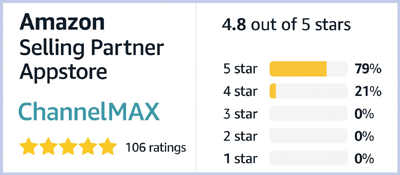
Check ChannelMAX at Amazon Selling Partner Appstore, an application with a 5 star rating.
By ChannelMAX Staff Writer
Sept-2026#04
Amazon sellers preparing for the 2026 holiday shopping season have received more time to finalize their promotional strategy for Prime Big Deal Days. The deal sourcing window has been extended through September 22, 2026, providing eligible sellers with additional time to submit deals and prepare inventory for the high-traffic event.
The extension was disclosed in an official update posted on Amazon Seller Central on September 8. Amazon is encouraging sellers to use the extra time not only to create promotions but also to review FBA inventory, improve inventory health and begin advertising campaigns before the event.
Deal Sourcing Now Open Through September 22
The September 22 deadline gives sellers who have not yet completed their Prime Big Deal Days promotions another opportunity to participate.
According to the Seller Central announcement, eligible promotional formats include Best Deals, Lightning Deals, Prime Exclusive Discounts and coupons. Sellers should check their individual Seller Central accounts because deal eligibility, recommended products, pricing requirements and available promotion types can vary by ASIN and account.
For sellers, the extension is particularly useful if they need more time to determine which products can support deeper discounts while remaining profitable. Rather than selecting products solely on sales volume, sellers should consider margins, inventory levels, advertising costs and expected demand before committing to a promotion.
Also Read: Amazon Seller Assistant Now Explains Why Your Offer Isn’t the Featured Offer
Prime Big Deal Days Pricing Gets an Important Q4 Advantage
One of the most significant points in Amazon’s announcement concerns promotional pricing.
Amazon said Prime Big Deal Days promotional prices will be excluded from the 30-day and 60-day lookback window used for determining the maximum deal price for Black Friday Week and Cyber Monday promotions.
This gives sellers greater flexibility when planning promotions across multiple Q4 events.
A seller may be able to offer an aggressive Prime Big Deal Days price without that promotional price negatively affecting the maximum deal price required for eligible Black Friday Week and Cyber Monday deals later in the season.
This distinction is important because sellers often need to balance short-term conversion gains against future promotional eligibility. Amazon’s clarification gives sellers more room to treat Prime Big Deal Days as a separate promotional opportunity while continuing to plan for the November shopping period.
Sellers Should Move FBA Inventory Early
Submitting a deal is only part of the preparation. Sellers using Fulfillment by Amazon need enough sellable inventory available before demand increases.
Amazon is advising sellers to make sure their FBA inventory reaches fulfillment centers ahead of the applicable cutoff dates for each sales event. Its Q4 readiness guidance also points sellers toward tools including Capacity Monitor, Capacity Manager, the Shipment Performance Dashboard, Send to Amazon and Amazon Warehousing and Distribution.
This makes inventory planning especially important during September. Sellers should compare expected Prime Big Deal Days demand against available inventory, inbound shipments and the stock they want to reserve for Black Friday and Cyber Monday.
Overstocked Sellers Get an Opportunity to Clear Inventory
Prime Big Deal Days could also serve a different purpose for sellers carrying excess inventory.
Amazon specifically highlighted products with more than 90 days of supply or inventory aged more than 180 days. Sellers can consider using the high-traffic shopping period to move these units and improve inventory health before the broader Q4 season.
Amazon also recommends considering Amazon Outlet for qualifying ASINs. Outlet can help sellers expose overstocked inventory to customers looking for discounted products.
For sellers, the objective should not simply be higher revenue. Reducing slow-moving inventory can free storage capacity, release working capital and reduce the risk of additional costs associated with keeping aging inventory in Amazon’s fulfillment network.
Advertising Should Begin Before the Event
Amazon is also advising sellers not to wait until Prime Big Deal Days begins before advertising their promotional products.
The company recommends starting campaigns early and using a full-funnel advertising strategy so deal ASINs can gain visibility and momentum before the event.
Amazon Ads separately recommends using performance data from campaigns running before Prime Day and Prime Big Deal Days to understand which targeting approaches work. Sellers without active campaigns can consider testing campaigns in advance to identify effective keywords and refine targeting before traffic increases.
That preparation can be particularly valuable for Sponsored Products campaigns. Sellers can identify converting search terms, remove inefficient targeting and determine which ASINs deserve larger advertising budgets during the event.
Watch Advertising Economics Alongside Discounts
Higher traffic does not automatically mean higher profits.
Sellers should calculate the combined effect of the promotional discount, Amazon selling and fulfillment fees, advertising costs and other applicable expenses before submitting a deal or increasing advertising budgets.
A product generating substantially higher sales during Prime Big Deal Days may still deliver weaker profitability if the discount and advertising spend are too aggressive.
Sellers should therefore establish target margins and advertising thresholds before the event. Performance can then be monitored during the promotional period, allowing budgets and bids to be adjusted based on actual conversion and profitability.
A Practical Prime Big Deal Days Checklist
Before September 22, sellers should review eligible ASINs in Seller Central, select the most appropriate promotion type and confirm that the promotional price leaves sufficient margin.
They should also check FBA inventory levels and inbound shipments, identify products with excessive days of supply, evaluate aging inventory for potential Outlet opportunities and review storage capacity for the rest of Q4.
Advertising campaigns should ideally be active before the event so sellers have useful performance data available when traffic rises.
Finally, sellers planning Black Friday Week and Cyber Monday promotions should build a combined Q4 strategy rather than treating each event separately. Inventory, pricing and advertising budgets should account for demand across the entire holiday period.
What Sellers Should Do Now
The extended September 22 deal sourcing deadline gives Amazon sellers additional preparation time, but the greatest benefit will come from using that time strategically.
Sellers can reassess promotional candidates, move FBA inventory into position, address slow-moving stock and begin building advertising momentum ahead of Prime Big Deal Days. The additional flexibility around promotional-price lookback rules also makes it easier to plan aggressive Prime Big Deal Days offers without automatically compromising Black Friday Week and Cyber Monday deal eligibility.
With several major shopping periods concentrated in Q4, sellers should view Prime Big Deal Days as the beginning of a broader holiday strategy rather than an isolated sales event. Careful coordination of pricing, inventory and advertising can help sellers use the extended deadline to pursue stronger sales while protecting margins and maintaining enough stock for the remainder of the holiday season.
Also Read: Amazon Offers 35 Percent Off MCF Fulfillment Fees for TikTok Shop Orders
Disclaimer:
Amazon is the registered trademark of the company.
About ChannelMAX.NET:
ChannelMAX offers Amazon Repricer that runs on the latest AI Repricing algorithm to do Amazon Pricing Management or Amazon Repricing. Based on Amazon SP API, the repricing engine or repricer runs 24/7 and efficiently manages Amazon prices to maximize your BuyBox with profit optimization. Established in 2005, ChannelMAX has been integrated with Amazon technology since 2007, helping thousands of third-party sellers on various eCommerce platforms. Some of the eCommerce platforms, aka marketplaces, supported by ChannelMAX.NET, are Amazon, Walmart, eBay, and Shopify. Some of ChannelMAX key offerings include ChannelMAX Amazon Repricer, 2ndly, ChannelMAX Amazon FBA Audits and FBA Refunds management, an offering for managing Amazon FBA Refunds Reimbursement management for lost or damaged or misplaced inventory for which Amazon is responsible and for which sellers deserve appropriate credit reimbursement from Amazon. ChannelMAX Services offer Remote (aka Virtual) Full-Time eCommerce Assistant to help 3P sellers run their daytoday business.
Check ChannelMAX at Amazon Selling Partner Appstore, an application with a 5 star rating.