Amazon Raises FBA and MCF Fuel Surcharge to 2% in UK and European Markets

Higher charges begin in November 2026, giving sellers time to review fulfillment costs, pricing and holiday margins
By ChannelMAX Staff Writer
Oct-2026#12
Sellers using Amazon’s fulfillment services in the UK and affected European markets face higher costs this November as the fuel and logistics-related surcharge increases from 1.5% to 2%. Reviewing the change now can help businesses prepare more accurate budgets and protect margins during the holiday selling period.
In its update on Seller Central, Amazon attributed the increase to continuing fuel and logistics cost pressures. The company introduced the surcharge in April 2026 to recover part of these elevated costs.
When the Higher Surcharge Takes Effect
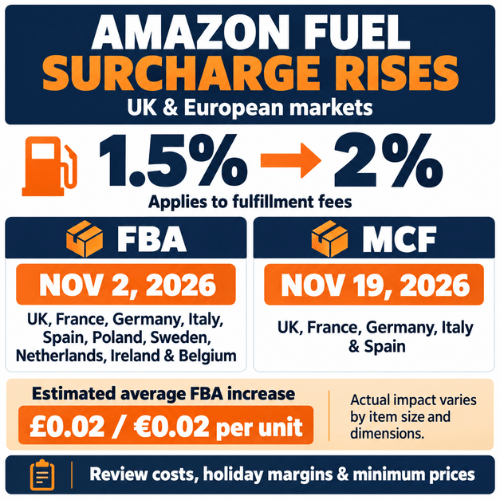
For Fulfillment by Amazon, the 2% surcharge takes effect on November 2, 2026, in the UK, France, Germany, Italy, Spain, Poland, Sweden, the Netherlands, Ireland and Belgium. For Multi-Channel Fulfillment, the increase begins on November 19, 2026, in the UK, France, Germany, Italy and Spain.
The separate dates matter for businesses using both services. MCF allows sellers to use Amazon’s fulfillment network for orders received through other sales channels, including their own websites. These businesses should account for the change in their off-Amazon order costs as well.
Also Read: Amazon Extends Holiday Return Window for 2026 Purchases, Giving Shoppers Until January 31, 2027
How the Surcharge Is Calculated
The surcharge applies to fulfillment fees, rather than the selling price of a product. Amazon estimates an average FBA increase of £0.02 or €0.02 per unit, with the actual amount varying by item size and dimensions. The move from 1.5% to 2% represents a 0.5-percentage-point increase. It does not mean sellers will pay an additional 2% of their sales revenue.
For illustration, if the applicable fulfillment fee before the surcharge is £4, the existing 1.5% surcharge is £0.06. At 2%, it becomes £0.08. The additional cost is £0.02 per unit, assuming the underlying fee stays unchanged. At that illustrative rate, 10,000 fulfilled units would generate £200 in additional costs. Even a small per-unit adjustment can therefore matter for high-volume products.
Updated Tools Help Sellers Assess the Impact
Amazon says Profit Analytics, Revenue Calculator, and Fee and Economics Preview reports have been updated to reflect the surcharge. These tools help sellers assess both the per-unit impact and the broader effect on their FBA business. Sellers should review individual products before making pricing decisions. A product-level assessment is more useful than applying Amazon’s average increase across an entire catalog.
When updating spreadsheets or external pricing tools, sellers should check whether the new surcharge is already included in imported fee estimates. Adding it again would overstate costs and could lead to unnecessary price increases.
Review Holiday Discounts and Minimum Prices
The November implementation dates make this a useful time to reassess planned holiday offers. Sellers should calculate expected profit after fulfillment costs, referral fees, advertising expenses, discounts and other relevant costs. Products with narrow margins deserve particular attention. A small increase may have limited impact on a higher-margin item but could reduce the remaining profit on a heavily discounted product.
Businesses using automated repricing should also review their minimum price settings. These should reflect current costs and the seller’s intended margin, rather than older fee assumptions. For businesses using both FBA and MCF, separate cost forecasts will make the staggered implementation easier to manage. MCF calculations should use the applicable MCF fees rather than assuming Amazon’s stated FBA average applies.
Preparing Before November
The higher surcharge gives sellers a clear reason to refresh their cost calculations before November. Checking product-level fees, reviewing promotional margins and updating pricing assumptions can help businesses make informed decisions about which offers remain profitable.
Amazon says it will continue evaluating the surcharge as conditions evolve. Sellers should monitor further Seller Central updates while incorporating the announced increase into their budgets. Early preparation can reduce the risk of unexpected margin pressure after holiday orders have been fulfilled.
Also Read: Amazon Extends Black Friday Cyber Monday Deal Deadline to November 13
Disclaimer:
Amazon is the registered trademark of the e-commerce brand.
About ChannelMAX.NET:
ChannelMAX offers Amazon Repricer that runs on the latest AI Repricing algorithm to do Amazon Pricing Management or Amazon Repricing. Based on Amazon SP API, the repricing engine or repricer runs 24/7 and efficiently manages Amazon prices to maximize your BuyBox with profit optimization. Established in 2005, ChannelMAX has been integrated with Amazon technology since 2007, helping thousands of third-party sellers on various eCommerce platforms. Some of the eCommerce platforms, aka marketplaces, supported by ChannelMAX.NET, are Amazon, Walmart, eBay, and Shopify. Some of ChannelMAX key offerings include ChannelMAX Amazon Repricer, 2ndly, ChannelMAX Amazon FBA Audits and FBA Refunds management, an offering for managing Amazon FBA Refunds Reimbursement management for lost or damaged or misplaced inventory for which Amazon is responsible and for which sellers deserve appropriate credit reimbursement from Amazon. ChannelMAX Services offer Remote (aka Virtual) Full-Time eCommerce Assistant to help 3P sellers run their daytoday business.
Check ChannelMAX at Amazon Selling Partner Appstore, an application with a 5 star rating.
By ChannelMAX Staff Writer
Oct-2026#12
Sellers using Amazon’s fulfillment services in the UK and affected European markets face higher costs this November as the fuel and logistics-related surcharge increases from 1.5% to 2%. Reviewing the change now can help businesses prepare more accurate budgets and protect margins during the holiday selling period.
In its update on Seller Central, Amazon attributed the increase to continuing fuel and logistics cost pressures. The company introduced the surcharge in April 2026 to recover part of these elevated costs.
When the Higher Surcharge Takes Effect
For Fulfillment by Amazon, the 2% surcharge takes effect on November 2, 2026, in the UK, France, Germany, Italy, Spain, Poland, Sweden, the Netherlands, Ireland and Belgium. For Multi-Channel Fulfillment, the increase begins on November 19, 2026, in the UK, France, Germany, Italy and Spain.
The separate dates matter for businesses using both services. MCF allows sellers to use Amazon’s fulfillment network for orders received through other sales channels, including their own websites. These businesses should account for the change in their off-Amazon order costs as well.
Also Read: Amazon Extends Holiday Return Window for 2026 Purchases, Giving Shoppers Until January 31, 2027
How the Surcharge Is Calculated
The surcharge applies to fulfillment fees, rather than the selling price of a product. Amazon estimates an average FBA increase of £0.02 or €0.02 per unit, with the actual amount varying by item size and dimensions. The move from 1.5% to 2% represents a 0.5-percentage-point increase. It does not mean sellers will pay an additional 2% of their sales revenue.
For illustration, if the applicable fulfillment fee before the surcharge is £4, the existing 1.5% surcharge is £0.06. At 2%, it becomes £0.08. The additional cost is £0.02 per unit, assuming the underlying fee stays unchanged. At that illustrative rate, 10,000 fulfilled units would generate £200 in additional costs. Even a small per-unit adjustment can therefore matter for high-volume products.
Updated Tools Help Sellers Assess the Impact
Amazon says Profit Analytics, Revenue Calculator, and Fee and Economics Preview reports have been updated to reflect the surcharge. These tools help sellers assess both the per-unit impact and the broader effect on their FBA business. Sellers should review individual products before making pricing decisions. A product-level assessment is more useful than applying Amazon’s average increase across an entire catalog.
When updating spreadsheets or external pricing tools, sellers should check whether the new surcharge is already included in imported fee estimates. Adding it again would overstate costs and could lead to unnecessary price increases.
Review Holiday Discounts and Minimum Prices
The November implementation dates make this a useful time to reassess planned holiday offers. Sellers should calculate expected profit after fulfillment costs, referral fees, advertising expenses, discounts and other relevant costs. Products with narrow margins deserve particular attention. A small increase may have limited impact on a higher-margin item but could reduce the remaining profit on a heavily discounted product.
Businesses using automated repricing should also review their minimum price settings. These should reflect current costs and the seller’s intended margin, rather than older fee assumptions. For businesses using both FBA and MCF, separate cost forecasts will make the staggered implementation easier to manage. MCF calculations should use the applicable MCF fees rather than assuming Amazon’s stated FBA average applies.
Preparing Before November
The higher surcharge gives sellers a clear reason to refresh their cost calculations before November. Checking product-level fees, reviewing promotional margins and updating pricing assumptions can help businesses make informed decisions about which offers remain profitable.
Amazon says it will continue evaluating the surcharge as conditions evolve. Sellers should monitor further Seller Central updates while incorporating the announced increase into their budgets. Early preparation can reduce the risk of unexpected margin pressure after holiday orders have been fulfilled.
Also Read: Amazon Extends Black Friday Cyber Monday Deal Deadline to November 13
Disclaimer:
Amazon is the registered trademark of the e-commerce brand.
About ChannelMAX.NET:
ChannelMAX offers Amazon Repricer that runs on the latest AI Repricing algorithm to do Amazon Pricing Management or Amazon Repricing. Based on Amazon SP API, the repricing engine or repricer runs 24/7 and efficiently manages Amazon prices to maximize your BuyBox with profit optimization. Established in 2005, ChannelMAX has been integrated with Amazon technology since 2007, helping thousands of third-party sellers on various eCommerce platforms. Some of the eCommerce platforms, aka marketplaces, supported by ChannelMAX.NET, are Amazon, Walmart, eBay, and Shopify. Some of ChannelMAX key offerings include ChannelMAX Amazon Repricer, 2ndly, ChannelMAX Amazon FBA Audits and FBA Refunds management, an offering for managing Amazon FBA Refunds Reimbursement management for lost or damaged or misplaced inventory for which Amazon is responsible and for which sellers deserve appropriate credit reimbursement from Amazon. ChannelMAX Services offer Remote (aka Virtual) Full-Time eCommerce Assistant to help 3P sellers run their daytoday business.
Check ChannelMAX at Amazon Selling Partner Appstore, an application with a 5 star rating.