Avoiding Amazon Deactivation for Pricing Errors: Best Practices for Sellers

Stay Compliant and Prevent Listing Suspensions with Smart Pricing Strategies
By ChannelMAX Staff Writer
Mar-2025#17
Pricing errors on Amazon can result in product listing deactivation, lost sales, and even account suspension. Amazon has strict pricing policies to protect buyers from unfair pricing and prevent system manipulation.
If your product price fluctuates too much or doesn't match Amazon's pricing guidelines, your listing may be removed or suppressed. This article focuses on preventing pricing errors before they occur, ensuring that your listings remain active and your sales continue smoothly.
What is a Potential Pricing Error on Amazon?
A Potential Pricing Error on Amazon occurs when Amazon's system detects that a product's price is either too high or too low compared to past prices, competitor prices, or Amazon’s internal pricing guidelines. Amazon watches price changes closely to keep prices fair and stop overpricing or sudden big discounts. If this happens, Amazon might hide your listing, remove the Buy Box, or deactivate the product to prevent unfair pricing practices.
Why does Amazon Deactivate Listings for Pricing Errors?
Amazon has strict pricing rules to keep competition fair and give customers a good shopping experience. Common reasons for pricing-related deactivation include:
1. Drastic Price Drops: If you suddenly lower a product’s price significantly (e.g., from $50 to $10), Amazon might see it as a mistake. This could happen if there’s an error in your pricing settings, a wrong discount, or even a possible scam. Amazon may also think you are selling at an unauthorized discount or trying to clear stock in a way that breaks their rules.
2. Excessive Price Increases: If you raise a product’s price too much in a short time (e.g., from $20 to $800), Amazon may suspect overpricing and block your listing. This is to stop sellers from overcharging customers, especially during high-demand times like holidays or product shortages.
3. Competitor Price Mismatch: If your product is priced much higher than similar listings on Amazon or lower than your prices on other marketplaces (e.g., Walmart, eBay), Amazon may intervene. Amazon checks your price against other sellers. If your price is much higher, Amazon may hide your listing to prevent unfair pricing. If it’s much lower, Amazon might think it’s a mistake and remove the listing. This is especially important for well-known brands, where Amazon expects similar prices across all sellers.
4. Unrealistic Discounts: Applying very high discounts (e.g., 90% off) can trigger Amazon’s algorithm to suppress your listing. Their system may think it’s a mistake or an attempt to manipulate sales, which may cause Amazon to mark your price as an error. To avoid this, make sure your discounts follow normal industry standards.
5. Incorrect Min/Max Prices: If you set unrealistic minimum or maximum price limits in Amazon’s pricing settings, your product listing may get suppressed. If you use Amazon’s Automated Pricing Tool or a third-party repricer, setting very low or high price limits can cause issues. If your price goes below the minimum or above the maximum you set, Amazon might remove the Buy Box or hide your listing. Always double-check your price limits to avoid problems.
Best Practices to Avoid Potential Pricing Errors and Deactivations
1. Use Automated Repricing with Safety Limits: Changing prices manually can be risky because it increases the chances of human errors, sudden price drops, or unrealistic spikes. Instead, using an AI-powered repricer like ChannelMAX helps you:
a. Keep prices within Amazon’s acceptable range, so your listings don’t get deactivated.
b. Avoid big price drops that could reduce profits or cause issues.
c. Adjust prices automatically based on competitor prices, demand, and sales velocity.
By using ChannelMAX, you can eliminate pricing mistakes while ensuring that your product remains competitive and compliant with Amazon’s pricing rules.
Also Read: How Amazon Repricing Tools Work: A Guide for New Sellers
2. Set a Minimum and Maximum Price Range: Amazon allows sellers to set floor (minimum) and ceiling (maximum) prices for their products. This helps them avoid pricing mistakes that could result in the removal of their listings.
a. Minimum Price: Stops your product from being sold at an unprofitable rate, ensuring you don’t lose money.
b. Maximum Price: Prevents Amazon from thinking you are overcharging, which could cause problems.
Example: If your product usually sells for $25, you can set a minimum price of $20 and a maximum price of $35. This way, even if prices change automatically, they stay within a safe range.
3. Regularly Monitor Competitor Prices: Amazon’s pricing rules depend a lot on market competition. If your price is much higher or lower than others, Amazon might hide or remove your listing.
To avoid this:
a. Use Amazon Business Reports to check competitor prices.
b. Monitor pricing trends on third-party sites like Walmart and eBay, as Amazon compares prices across multiple platforms.
c. Use a repricing tool like ChannelMAX to automate price adjustments based on competitor pricing while keeping your margins profitable.
By staying competitive without violating Amazon’s pricing rules, you can reduce the risk of listing deactivation while maximizing sales.
4. Avoid Sudden Price Spikes or Drops: Amazon may flag your product if there are drastic and unexpected price changes. This can indicate errors, manipulation, or unfair pricing practices. Here’s how to avoid this issue:
a. Increase prices slowly – Instead of jumping from $20 to $50 at once, increase the price step by step, like $20 to $25, then $30, and so on.
b. Use smart pricing tools – AI-powered repricers like ChannelMAX adjust prices dynamically based on market trends without causing issues with Amazon.
c. Be careful with big discounts – If you temporarily lower your price for a sale but forget to change it back, Amazon might think it's an error when you raise it back to normal.
By making price changes gradually, you can stay competitive without risking your listing being flagged or deactivated.
5. Keep Pricing Consistent Across Platforms: Amazon actively monitors how you price your products on other eCommerce websites like Walmart, eBay, and Shopify. If Amazon finds that your product is priced much lower on another site, it may hide your listing or even remove the Buy Box.
To avoid problems:
a. Maintain a consistent pricing strategy across all marketplaces to avoid conflicts.
b. Avoid offering big discounts on other platforms that may cause Amazon to see your pricing as unfair.
c. Use pricing automation tools like ChannelMAX to keep prices uniform across all marketplaces.
Keeping prices balanced across different sales channels will help prevent Amazon from flagging your listing due to external price mismatches.
How to Reactivate a Deactivated Listing Due to Pricing Errors?
If Amazon has deactivated your product listing because of a pricing error, you need to take immediate action to fix the issue and get your product back online. Follow these steps to reactivate your listing and avoid future problems.
1. Identify the Issue: The first step in reactivating a deactivated listing is to determine why Amazon flagged your listing as a pricing error.
a. Log in to Amazon Seller Central and go to Pricing Health under the Manage Inventory section.
b. Look for alerts or notifications explaining the issue, such as "High Pricing Error" or "Price Fairness Violation." Amazon usually provides a reason for the deactivation.
c. Compare your product's price with past trends and competitor prices to identify any significant price fluctuations that may have triggered Amazon’s system.
By identifying the exact reason behind the deactivation, you can take action to resolve the issue and prevent it from happening again.
2. Adjust Your Pricing: Once you’ve identified the issue, the next step is to update your product’s pricing to comply with Amazon’s fair pricing guidelines.
a. Ensure your price falls within a competitive range: Compare your pricing with similar products in your category. If your price is too high, Amazon may consider it as price gouging. If it’s too low, it could be flagged as an error.
b. Check your Min/Max pricing limits: If you are using Amazon’s Automated Pricing Tool or a third-party repricer like ChannelMAX, verify that your pricing limits are reasonable.
c. Make gradual price adjustments: Instead of making sudden, drastic changes, adjust prices slowly to prevent Amazon’s system from flagging them.
After updating the price, it may take a few hours to 24-48 hours for Amazon’s system to update your listing.
3. Submit a Plan of Action (POA) to Amazon: If simply adjusting your pricing does not automatically reactivate your listing, you may need to submit a Plan of Action (POA) to Amazon. Your POA should be clear, concise, and provide Amazon with three key elements:
a. What caused the issue? Explain that the pricing error was due to incorrect pricing settings, competitor pricing changes, or an automated repricing tool.
b. What corrective actions have you taken to fix it? Describe how you have updated the price to align with market trends and Amazon’s pricing guidelines.
c. What steps will you take to prevent it from happening again? Mention that you will monitor pricing more closely, set proper Min/Max limits, and use tools like ChannelMAX to maintain compliance.
A well-structured POA increases your chances of getting your listing reinstated quickly.
4. Request a Review: If your listing is still deactivated after submitting a POA and adjusting the price, you may need to request a manual review from Amazon’s support team.
a. Go to the "Account Health" dashboard in Seller Central and find the Pricing Policy Violations section.
b. Click on the deactivated listing and select the option to Request a Review.
c. Provide additional details, such as competitor pricing comparisons or past sales data, to prove that your pricing is fair and justified.
d. If needed, contact Amazon Seller Support via chat or phone to escalate the issue.
Once your request is submitted, Amazon usually takes 24-48 hours to review and respond. If the review is approved, your listing will be reinstated, and you can continue selling without further issues.
Conclusion
Amazon pricing mistakes can harm your business, but with the right approach, you can avoid listing deactivation and maintain a healthy seller account. Managing your prices wisely helps prevent problems before they happen.
Use AI-powered repricers like ChannelMAX for smart and fair pricing, set a minimum and maximum price to avoid big price changes, keep an eye on competitor prices, make small, gradual adjustments instead of sudden spikes, and ensure your prices are consistent across all marketplaces.
By automating pricing, setting safeguards, and tracking competitors, you can avoid pricing mistakes before they affect your sales. Stay compliant, stay competitive, and keep growing your Amazon business!
Also Read: ChannelMAX Unveils New Repricing Interface
Disclaimer:
Amazon is the registered trademark of the e-commerce brand.
About ChannelMAX.NET:
ChannelMAX offers Amazon Repricer that runs on the latest AI Repricing agents to do Amazon Pricing Management or Amazon Repricing. Based on Amazon SP API, the repricing engine or repricer runs 24/7 and efficiently manages Amazon prices to maximize your BuyBox with profit optimization. Established in 2005, ChannelMAX has been integrated with Amazon technology since 2007, helping thousands of third-party sellers on various eCommerce platforms. Some of the eCommerce platforms, aka marketplaces, supported by ChannelMAX.NET, are Amazon, Walmart, eBay, and Shopify. Some of ChannelMAX key offerings include ChannelMAX Amazon Repricer, 2ndly, ChannelMAX Amazon FBA Audits and FBA Refunds management, an offering for managing Amazon FBA Refunds Reimbursement management for lost or damaged or misplaced inventory for which Amazon is responsible and for which sellers deserve appropriate credit reimbursement from Amazon. ChannelMAX Services offer Remote (aka Virtual) Full-Time eCommerce Assistant to help 3P sellers run their daytoday business.
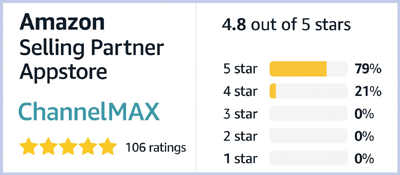
Check ChannelMAX at Amazon Selling Partner Appstore, an application with a 5 star rating.