How Repricing Affects Amazon Search Ranking
Why Price Changes Influence Visibility, Sales, and Long-Term Performance
By ChannelMAX Staff Writer
Feb-2026#A04
Most Amazon sellers think about repricing only when they lose the Buy Box or when a competitor lowers their price. At that moment, the main goal is often to match or beat the competition. Search ranking is often ignored. Very few sellers think about how these price changes affect their search ranking. In reality, pricing and ranking are closely connected.
On Amazon, price affects how customers respond to your product. A better price can improve both click-through rates and conversion rates. More conversions lead to more sales. And when your product sells consistently, Amazon’s algorithm sees it as relevant and valuable. This can help improve your organic ranking over time.
At the same time, pricing too low can hurt your margins, and pricing too high can reduce conversions. That is why repricing is not just about reacting to competitors. It is about finding the right balance that supports both short-term sales and long-term visibility.
In this article, we’ll discuss how repricing directly and indirectly affects Amazon search ranking and the key metrics influenced by price changes.
Amazon Ranks Products That Perform Well
Search ranking on Amazon depends largely on how well a product performs. While keywords help a product appear in search results, performance decides how high it ranks and how long it stays there.
Amazon ranks products that buyers actually purchase and trust. Products that sell regularly and keep customers satisfied are more likely to stay visible in search results.
Some of the most important performance metrics include:
a. How often a product sells (sales volume)
b. How steady those sales are over time
c. Conversion rate (how many visitors turn into buyers)
d. Buy Box win rate
e. Seller performance factors, such as on-time delivery and low cancellations
f. How competitive your price is compared to similar products
All these metrics work together. Strong performance tells Amazon that buyers prefer your product. This increases the chances of better placement in search results.
Pricing influences many of these metrics at the same time. A competitive price can improve clicks, increase conversions, and help win the Buy Box. This leads to more and consistent sales. Steady sales are especially important because they show ongoing demand.
Repricing does not directly change your search ranking. But it influences the performance metrics that are important on Amazon. That is why smart repricing can indirectly support better visibility, stronger sales, and long-term ranking stability.
Also Read: How Seller Metrics Matter to Amazon
Price Has a Big Impact on Clicks and Conversions
On Amazon, buyers make decisions very quickly. When they search for a product, they do not read everything in detail at first. Instead, they quickly go through the search results page. The main things they usually notice are:
a. Product image
b. Title
c. Star rating and number of reviews
d. Price
Among these, price is one of the first things buyers compare. Even before checking reviews or descriptions, shoppers compare your price with similar products. If your price is higher than other similar listings:
a. Fewer shoppers click on your listing
b. Click-through rate (CTR) goes down
c. Conversion rate decreases
d. Sales begin to slow down
Over time, your listing can lose visibility in search results. Fewer people see your product, which leads to even fewer sales.
On the other hand, a competitive price can make a big difference. When your price feels fair and aligned with the market:
a. More buyers click on your listing
b. Conversion rate improves
c. Sales increase steadily
d. Chances of winning the Buy Box improve
Strong sales and good conversions help your product move higher in organic search rankings. Price does not work alone. Reviews, fast shipping, and a good listing also matter. But price is often the reason a buyer clicks your product in the first place. Without that click, even the best listing may not get sales.
That is why smart repricing is important. It helps you stay competitive, protect your sales, and support better search visibility in the long run.
Also Read: How to Get Reviews on Amazon?
Buy Box Wins Have a Big Impact on Search Visibility
On Amazon, most sales happen through the Buy Box. Many sellers focus on ranking but forget that ranking alone does not guarantee sales. Your product may appear on the first page, but you do not own the Buy Box. Buyers usually choose the default Buy Box offer instead of comparing other sellers. That means you get visibility, but not the sale.
When you lose the Buy Box:
a. Sales volume drops quickly
b. Conversion rate goes down
c. Overall listing activity slows down
d. Revenue becomes unstable
Since Amazon prefers products that sell consistently, losing the Buy Box can slowly affect your search visibility over time.
Repricing plays a major role here, especially when multiple sellers are offering the same product. A smart repricing strategy helps you:
a. Stay competitive without racing to the lowest price
b. Win the Buy Box more often
c. Hold the Buy Box for longer periods
d. Adjust quickly when competitors change prices
When you consistently win the Buy Box, your sales become more stable. Stable and predictable sales are very important for the Amazon’s ranking system because they show ongoing demand.
In simple terms, more Buy Box time usually means more consistent sales. And consistent sales help maintain or improve your product’s visibility in Amazon search results. That is why Buy Box control supports long-term ranking performance.
Also Read: Why Amazon Sellers Lose the Buy Box (And How to Fix It)
Pricing Influences Seller Metrics Indirectly
On Amazon, seller performance metrics are very important. These metrics include late shipment rate, order defect rate, cancellations, and overall account health. Price does not directly change these metrics, but pricing decisions can still affect them indirectly. This is why pricing needs to be managed carefully.
For example, if you lose the Buy Box because your price is not competitive, your order volume may drop. When you have fewer orders, even a small number of late shipments or cancellations can have a bigger impact on your performance percentage. This can make your account metrics look worse than they actually are.
On the other hand, very aggressive repricing can create the opposite problem. If you suddenly lower your price too much:
a. Orders may increase very quickly
b. Inventory may run out faster than expected
c. Your team may struggle to ship on time
d. Cancellations or delays may increase
When fulfillment cannot keep up with sudden sales spikes, seller metrics get affected. Late shipments, stockouts, and negative feedback can hurt buyer trust. Over time, weak performance can affect both account health and search visibility.
Amazon prefers sellers who maintain a healthy balance. This means pricing competitively while still being able to fulfill orders smoothly and on time.
Stable pricing decisions usually lead to stable order volume. Stable order volume makes it easier to maintain good performance metrics. And strong seller metrics help support steady search rankings in the long run.
Also Read: Important Seller Metrics to Monitor While Repricing on Amazon
Frequent Price Changes Can Hurt Your Ranking
Many sellers think that constantly lowering prices will always boost sales and search ranking. But in reality, changing prices too often or by large amounts can cause problems instead of helping.
Some of the main issues with frequent price changes are:
a. Lower profit margins – Constantly dropping prices can reduce profits and sometimes cause stock problems if orders come in faster than you can handle.
b. Price wars – Competing sellers may lower their prices too, which can reduce the overall value of your product category.
c. Unstable Buy Box ownership – When prices change too much, it can be more challenging to stay in the Buy Box consistently.
d. Unpredictable sales patterns – Sudden ups and downs in sales make your product look less reliable to Amazon.
Amazon prefers listings that show steady, predictable performance. If your pricing is constantly changing, the algorithm may see your product as unstable, which can hurt your ranking over time.
Instead, a controlled approach to repricing works better. Adjust prices carefully, keep them competitive, and avoid reacting to every small competitor move. This helps maintain steady sales, improves your chances of holding the Buy Box, and supports better search visibility in the long run.
Also Read: Amazon Repricing Strategies That Actually Work
Repricing Helps Listings Recover from Ranking Drops
Sometimes a product listing loses its position in Amazon search results. This can happen for several reasons:
a. Higher competition in the category– More sellers start offering the same product.
b. Market price changes – If the average price in your category drops, your listing may no longer appear attractive.
c. New competitors entering the listing – Fresh listings with competitive prices can push your product down.
d. Changes in demand – Seasonal or trend shifts can affect how often buyers search for your product.
When this happens, repricing can help bring your listing back into a competitive position. By adjusting your price to stay competitive with other sellers, you can attract more clicks and boost conversions. As sales increase, Amazon sees your product as more relevant and gradually improves its visibility. This approach is especially helpful for slow-moving or older listings.
It’s important to remember that recovery from a ranking drop does not happen instantly. Amazon evaluates performance over time, so consistent results matter more than quick, extreme price changes. Smart repricing can help your listing bring steady sales and perform better in the long term.
By actively managing your prices, you ensure your listing stays aligned with current market conditions, making it easier to compete, win the Buy Box, and improve overall search visibility.
Ranking Improvement Takes Time
It’s important to understand that repricing does not instantly move a product to the top of Amazon search results. Ranking changes happen gradually, especially in competitive categories where many sellers are constantly adjusting prices, improving listings, and competing for visibility.
Repricing helps your listing become more competitive over time. By adjusting your price strategically, you can:
a. Increase conversions – More buyers are likely to click and purchase when your price is attractive.
b. Improve Buy Box presence – Competitive pricing can help you win the Buy Box more often, which drives more sales.
c. Restore sales momentum – Steady sales send positive signals to Amazon’s algorithm, helping your listing regain visibility in search results.
A consistent, well-planned pricing strategy helps build lasting results. Over time, these improvements in sales, conversions, and Buy Box wins gradually improve your search ranking and overall visibility.
To sum up, repricing is more than just changing the price on your Amazon product listing. It affects how buyers react, how often you win the Buy Box, and how steadily your product sells. It also affects how Amazon sees your product and ranks it in search results.
If done carefully, repricing can help you sell more consistently, improve Buy Box performance, and rank better in search rankings. Smart repricing can increase both visibility and profit, while aggressive repricing can trigger price wars and hurt overall performance.
Good repricing keeps your product competitive, maintains steady sales, and gradually improves your position in Amazon search results.
Also Read: Automated Repricers: What Should You Spend and What Features Matter?
Disclaimer:
Amazon is the registered trademark of the e-commerce brand.
About ChannelMAX.NET:
ChannelMAX offers Amazon Repricer that runs on the latest AI Repricing algorithm to do Amazon Pricing Management or Amazon Repricing. Based on Amazon SP API, the repricing engine or repricer runs 24/7 and efficiently manages Amazon prices to maximize your BuyBox with profit optimization. Established in 2005, ChannelMAX has been integrated with Amazon technology since 2007, helping thousands of third-party sellers on various eCommerce platforms. Some of the eCommerce platforms, aka marketplaces, supported by ChannelMAX.NET, are Amazon, Walmart, eBay, and Shopify. Some of ChannelMAX key offerings include ChannelMAX Amazon Repricer, 2ndly, ChannelMAX Amazon FBA Audits and FBA Refunds management, an offering for managing Amazon FBA Refunds Reimbursement management for lost or damaged or misplaced inventory for which Amazon is responsible and for which sellers deserve appropriate credit reimbursement from Amazon. ChannelMAX Services offer Remote (aka Virtual) Full-Time eCommerce Assistant to help 3P sellers run their daytoday business.
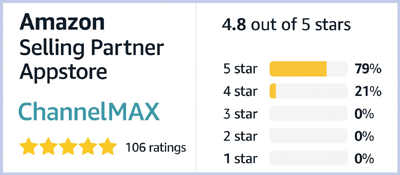
Check ChannelMAX at Amazon Selling Partner Appstore, an application with a 5 star rating.