Mastering Amazon SERP Optimization: Rank Higher and Sell Smarter

Learn how to boost your product rankings and visibility on Amazon's search results page.
By ChannelMAX Staff Writer
Apr-2025#19
In the world of Amazon selling, visibility is important for making sales. To do this, you need to understand how Amazon's Search Engine Results Page (SERP) works. Similar to how Google shows results based on what people search, Amazon has a system (called an algorithm) that decides which products to show based on customer searches. The higher your product appears on Amazon's SERP, the more people will notice and click on it.
In this article, we will explain why Amazon SERP is important, how it works, and how you can improve your product listings to get more visibility and sales. Whether you’re a new or an experienced seller, learning how to improve your position on Amazon’s search page can really help your business grow.
What is Amazon SERP?
Amazon SERP (Search Engine Results Page) is the list of product results that appears when a customer searches for something on Amazon. It is similar to Google’s SERP, but Amazon’s page shows a mix of organic product listings, sponsored ads, Amazon’s Choice products, and featured brands. It’s where customers first see your product, and for most sellers, it's the most important place to be seen.
When someone searches for something like “wireless earbuds,” Amazon’s SERP decides which products show up on page one, which ones on later pages, and which ones are promoted by ads. This is controlled by an algorithm called the Amazon A9 algorithm, which ranks products based on factors like relevance, performance, and customer experience.
Ranking high on the Amazon SERP means the product gets better visibility, more clicks, and ultimately, more sales. If your product isn't showing up on page one, you're losing valuable traffic to competitors who are there.
Why SERP Optimization Matters on Amazon?
SERP optimization is important for several reasons, as it affects how easily customers can find your products and how much you can sell on Amazon. Here’s why it matters:
1. Increased Visibility: The higher your product ranks on Amazon’s SERP, the more likely potential customers will see it. Since many buyers don’t scroll past the first page of search results, being at the top helps get your product noticed.
2. Better Click-Through Rates (CTR): When your product appears higher on the results page, people are more likely to click on it. Using the right keywords and good quality product pictures can make your listing more attractive and lead to more clicks, which means more sales.
3. Higher Conversion Rates: SERP optimization not only brings more visitors to your page, but it also helps turn them into buyers. Having a well-optimized listing with clear, engaging descriptions and the right keywords can encourage customers to make a purchase.
4. Better ROI on Ads: Optimizing your product for organic rankings can reduce the need to spend heavily on ads. By improving your product’s visibility for free, you can get more traffic at a lower cost, giving you a better return on investment.
5. Long-Term Success: While paid ads can help in the short run, long-term success on Amazon depends on how well your products rank organically. SERP optimization helps keep your product visible and competitive, even when you’re not spending on ads.
In short, optimizing for Amazon SERP is key to staying competitive, increasing visibility, and driving more sales on the platform.
Key Factors That Affect Amazon SERP Rankings
1. Product Title Optimization
The product title is the first thing both Amazon’s A9 algorithm and your potential customers see. A well-optimized title helps your product get noticed and increases click-through rate.
Why it matters: Amazon uses the title for relevant keywords to match your product with what customers search for.
How to do it right: Include primary keywords naturally without keyword stuffing. Add product-specific details like brand name, size, color, material, quantity, or model number. Keep it readable, and ideally under 200 characters.
2. Backend Keywords
These are hidden keywords you add in the backend of your listing. Customers don’t see them, but they help your product show up in more searches. They work as additional signals to Amazon’s search engine.
Why it matters: These keywords cover alternate spellings, synonyms, or less-used search terms that don't fit naturally in your visible content.
Tips: Avoid repeating keywords already used in your title or bullet points. Don't use brand names, competitor names, or irrelevant terms. Stick to generic, high-volume search terms relevant to your product.
3. High-Quality Product Images
Visuals play an important role in Amazon SERP performance and conversions. Clear and high-quality images help your product rank better and sell more.
Why it matters: Good images lead to more clicks and increase conversion rates, both of which Amazon’s algorithm monitors.
Tips: Use at least 6–7 high-resolution images (1000x1000 pixels or higher). Show your product from different angles, in use (lifestyle shots), infographics highlighting features, and size comparisons. Use at least one photo on a plain white background.
4. Competitive Pricing
Amazon wants to give customers the best deals. Competitive pricing helps you get noticed and boosts your chances of making a sale.
Why it matters: Overpriced products are less likely to convert and more likely to get flagged for “Potential Pricing Errors.”
How to stay ahead: Monitor competitors daily and keep your prices competitive. Use dynamic repricing tools like ChannelMAX to adjust prices smartly without sacrificing profit margins.
5. Conversion Rate (CR)
Conversion rate is the percentage of visitors who buy your product after clicking on your listing.
Why it matters: Amazon favors listings with good conversion rates because it suggests relevance and customer satisfaction.
How to improve it: Write clear, compelling copy, use strong call-to-actions (CTAs), provide detailed bullet points, relevant images, and offer competitive pricing. Also, consider adding A+ Content for better storytelling and buyer engagement.
6. Product Reviews and Ratings
Reviews are a form of social proof and heavily impact both product visibility and buying decisions.
Why it matters: More positive reviews lead to more customer trust, better conversions, and higher rankings.
How to build them: Politely ask customers for feedback after purchase, provide excellent customer service to reduce negative feedback, and use the “Request a Review” button to encourage reviews.
7. Sales Velocity
Sales velocity shows how quickly your product sells over a set period. Products that sell fast are more likely to rank higher.
Why it matters: Amazon boosts the ranking of fast-selling products because they show high demand and strong buyer interest.
How to boost it: Use Amazon ads (PPC), run special deals, reach out to influencers, or drive traffic from external sources like social media and email marketing.
8. Fulfillment Method (FBA vs. FBM)
Amazon favors FBA (Fulfillment by Amazon) listings in search rankings because they offer faster shipping, better customer service, and prime eligibility.
Why it matters: FBA listings tend to convert better, and better conversion rates help boost SERP rankings.
Tip: For better visibility, use FBA to get access to Prime customers and improve trust.
9. Product Availability
Out-of-stock listings can affect your SERP ranking. Amazon does not prioritize product listings that run out of stock often. Amazon pushes it down in search.
Why it matters: If a product is out of stock, customers can’t buy it. Amazon prioritizes listings that can be fulfilled promptly.
How to manage it: Use inventory management software or Amazon’s tools to track inventory levels and restock on time. Also, avoid creating too many variations of the same product that could spread inventory.
10. A+ Content (Enhanced Brand Content)
A+ Content is available to brand-registered sellers and allows them to create detailed and customized product descriptions.
Why it matters: Listings with A+ Content convert better, helping them rank higher in search results.
Best practices: Use attractive images, comparison charts, feature callouts, and storytelling to make your brand stand out. Keep your brand consistent across all listings.
Also Read: Mastering Amazon A+ Content: Guidelines for Creating High-Impact Product
Best Practices for SERP Optimization
Optimizing your Amazon listings for SERP (Search Engine Results Page) isn’t just about inserting keywords — it’s about creating a well-rounded, conversion-driven product page that both the Amazon algorithm and your customers will like. Here are some simple and effective tips to follow:
1. Conduct Thorough Keyword Research
Start with the right keywords — they’re the backbone of your Amazon SEO. Good keywords help people find your product.
a. Use Amazon’s Brand Analytics or other tools to discover high-volume, relevant keywords.
b. Use a mix of short-tail (like “wireless headphones”) and long-tail keywords (like “Bluetooth wireless headphones with mic”).
c. Track what keywords your top competitors are ranking for and try similar ones in your listings.
2. Optimize Titles with Primary Keywords
Your product title is the first thing people see. It should be clear, keyword-rich, and focused on what matters to the customer.
a. Place the most important keywords at the beginning of the title.
b. Add your brand name, product type, features (like size or color), and main use cases.
c. Keep it clear and easy to read. Don’t just stuff in keywords.
3. Improve Bullet Points and Descriptions
This is your chance to show buyers why they should choose your product.
a. Use bullet points to highlight main benefits and features.
b. Be clear and specific. For example, say “100% BPA-free, food-grade silicone” instead of just “high quality.”
c. In the description, talk about how your product helps, how to use it, and your brand story.
4. Use High-Quality Images and Videos
Visual content plays an important role in increasing click-through rate and conversion.
a. Add at least 6–7 images– main product photo, lifestyle images, close-ups, infographics, etc.
b. If you’re a Brand Registered seller, use Amazon’s video option to show the product in action or explain the main features.
c. Follow Amazon’s guidelines for image quality and size.
5. Maintain Competitive and Dynamic Pricing
Amazon rewards listings that are both competitively priced and actively managed. Keep your prices competitive and flexible.
a. Use repricing tools like ChannelMAX to adjust prices based on demand, competition, and Buy Box eligibility.
b. Monitor price history and avoid setting prices too high. It can lower your sales or even lead to deactivation due to pricing errors.
Common Mistakes to Avoid in Amazon SERP Optimization
While sellers focus on keyword strategy and listing optimization, small mistakes can prevent your product from ranking higher on Amazon's search results. Here are some common mistakes and how to avoid them:
1. Keyword Stuffing
Some sellers think using the same keyword over and over will help. Instead, it makes the listing hard to read and might lower your rank. Amazon's A9 algorithm also penalizes unnatural keyword usage.
Avoid it by: Prioritizing clarity. Use your main keyword once or twice in important areas (like the title, bullet points, and backend), and include secondary keywords naturally.
2. Not Updating Listings
Some sellers create a listing once and never touch it again. However, Amazon is always changing — new competitors enter the market, customer behavior shifts, and trends evolve. If your listing stays the same for months, it might become outdated, less visible in search, or less appealing to buyers.
Avoid it by: Regularly update listings with new keywords, A+ content, updated images, and seasonal offers. Small updates can make a big difference over time. Amazon rewards active, relevant listings that provide a better experience for shoppers.
3. Not Optimizing for Mobile Shoppers
Most Amazon shoppers use their phones to browse and buy. If your listing looks messy or hard to read on a small screen, shoppers may skip it. This might lead to lower clicks and push your product down in the search results.
Avoid it by: Use short sentences and bullet points. Make sure images look good on small screens. Open your product page on a mobile device to see how it looks. If it feels cluttered, simplify the content. Making your listing mobile-friendly improves the shopping experience, which helps boost clicks, conversions, and ultimately your ranking on Amazon.
4. Not Using A+ Content (Enhanced Brand Content)
If you’re a Brand Registered seller and not using A+ Content, you’re missing a powerful tool that can boost both your conversion rate and your search ranking. Many sellers skip this step, thinking it's optional, but A+ Content can make a huge difference.
Avoid it by: Add A+ Content to your listings with comparison charts, lifestyle images, and detailed product info. It helps build trust and improve sales, which also improves rankings. Use tools to see if your conversion rate improves after adding A+ Content.
5. Not Monitoring Performance Metrics
Without tracking metrics like click-through rate, conversion rate, and keyword rankings, you won’t know what’s helping your sales or what’s not.
Avoid it by: Use Amazon reports and third-party tools to monitor performance metrics. Make changes based on what works.
How to Measure SERP Optimization Success?
Optimizing your Amazon product listings is just the first step. The next step is measuring how well those changes perform. Here's how sellers can effectively monitor SERP (Search Engine Results Page) optimization success:
1. Track Keyword Rankings
Use reliable keyword tracking tools to monitor where your product appears in Amazon’s search results for targeted keywords. Tracking rankings helps you understand which keywords are doing well and which ones need improvement. Regular monitoring can also reveal seasonal trends or competitor activity.
2. Monitor CTR & Conversion Rates
Click-through rate (CTR) and conversion rate are essential indicators of listing performance. CTR (Click-Through Rate) shows how many people click your product after seeing it. The conversion rate shows how many of those people actually buy. These metrics are available inside Amazon Seller Central under the “Business Reports” or “Detail Page Sales and Traffic” reports.
A low CTR may mean your title, image, or price isn’t effective enough to get clicks. On the other hand, a low conversion rate indicates that people are visiting your page but not buying, so maybe your content or price needs optimization.
3. Analyze Sales & Traffic Data
Use tools like Brand Analytics, Search Query Performance, or Business Reports to understand how people find your listings, what search terms they use, and how your traffic and sales are growing. Monitor metrics like how many people visit your page (sessions), items they buy (units ordered), and total sales. If these numbers go up after optimization, it means your listing is more visible now.
4. A/B Test Your Listings
If you are a Brand Registered seller, use Amazon Experiments to test different versions of your product listing, like changing the title, images, bullet points, descriptions, or main image. Testing helps determine which version of your listing works best in driving conversions and engagement. For example, you can compare two main images to check which one gets more clicks and sales.
5. Monitor Organic vs. Paid Performance
Check how much of your traffic comes from organic (non-sponsored) search vs. paid advertising. You can do this by analyzing the Search Term Report and separating paid keywords from organic ranking keywords. If organic sales are going up even without spending more on ads, that’s a good sign that your SERP optimization is working well.
Conclusion
Optimizing your product for Amazon search results (SERP) is not something you do just once. It’s something you need to keep working on regularly. This process includes finding the right keywords, improving your product listings, setting prices smartly, and monitoring your product’s performance.
Sellers who spend time on SERP strategies have a better chance of standing out and getting more sales, even in a crowded market. Using tools can help make this process easier and more effective. By consistently applying these practices, your product will gain higher visibility, more traffic, and ultimately, more conversions on Amazon.
Also Read: Amazon UK Reduces FBA Parcel Fees for Clothing and Accessories
Disclaimer:
Amazon is the registered trademark of the e-commerce brand.
About ChannelMAX.NET:
ChannelMAX offers Amazon Repricer that runs on the latest AI Repricing agents to do Amazon Pricing Management or Amazon Repricing. Based on Amazon SP API, the repricing engine or repricer runs 24/7 and efficiently manages Amazon prices to maximize your BuyBox with profit optimization. Established in 2005, ChannelMAX has been integrated with Amazon technology since 2007, helping thousands of third-party sellers on various eCommerce platforms. Some of the eCommerce platforms, aka marketplaces, supported by ChannelMAX.NET, are Amazon, Walmart, eBay, and Shopify. Some of ChannelMAX key offerings include ChannelMAX Amazon Repricer, 2ndly, ChannelMAX Amazon FBA Audits and FBA Refunds management, an offering for managing Amazon FBA Refunds Reimbursement management for lost or damaged or misplaced inventory for which Amazon is responsible and for which sellers deserve appropriate credit reimbursement from Amazon. ChannelMAX Services offer Remote (aka Virtual) Full-Time eCommerce Assistant to help 3P sellers run their daytoday business.
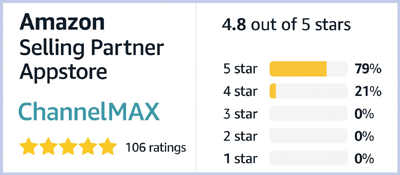
Check ChannelMAX at Amazon Selling Partner Appstore, an application with a 5 star rating.