Seller Challenge offers faster second review for Amazon Account Health Assurance sellers
Existing benefit lets eligible sellers challenge certain listing enforcement decisions three times every 180 days, with Amazon targeting decisions within 48 hours
Amazon is drawing fresh attention to its Seller Challenge benefit for Account Health Assurance sellers through a new announcement on Seller Central titled “Seller Challenge launches for Account Health Assurance.” The feature is already live for eligible sellers and is designed to give them a structured, fast-track way to request a second review of certain listing-level enforcement decisions after they have used the standard appeal routes.

What is Seller Challenge under Account Health Assurance
Seller Challenge is an added review path that sits on top of Amazon’s existing appeal process. It is available only to sellers enrolled in the Account Health Assurance (AHA) program, which protects qualifying accounts from sudden deactivation as long as they engage promptly to resolve issues.
When a listing is deactivated or flagged for certain policy reasons, a seller must first go through the normal appeal steps. If those attempts fail and the case qualifies, the seller can trigger a Seller Challenge from within Seller Central. This sends the enforcement decision for an enhanced review by a dedicated Amazon team.
How the three-challenge limit works
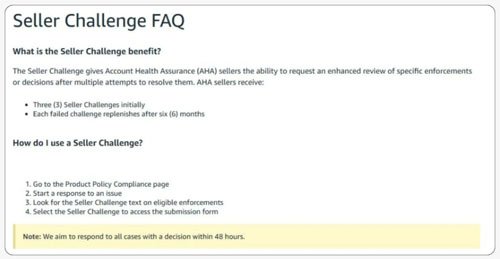
Under the current design, each eligible account receives three Seller Challenge opportunities in every 180-day period. These are sometimes described as “slots” or “chances” in community discussions.
Key points on how these slots work:
• You can use Seller Challenge only on specific listing-level enforcement actions, not on broad account-level issues.
• You get three challenge slots per 180 days.
• If a challenge is successful and Amazon overturns the enforcement, that slot becomes available again.
• If a challenge is denied, the used slot replenishes after six months.
Amazon says its trained teams aim to deliver a decision within about 48 hours, which is much faster than many standard appeals and escalations that can drag on for days or weeks.
Where to find Seller Challenge in Seller Central
The latest announcement makes clear that the update has been communicated through the Seller Central interface itself. Inside Seller Central, eligible sellers will see Seller Challenge in the Product Policy Compliance section of the Account Health area when a particular enforcement qualifies for this path.
In practice, the flow usually looks like this:
i) The seller receives a listing-level enforcement, such as a suspected policy violation.
ii) The seller submits one or more standard appeals and receives decisions.
iii) If the case remains unresolved and is eligible, a Seller Challenge option appears alongside the enforcement notice under Product Policy Compliance.
iv) The seller submits a fresh, more detailed dossier using the Seller Challenge form.
Importantly, if a listing is deactivated when you start a challenge, it normally stays deactivated during the review, so sellers should weigh the impact on sales before using a slot.
Who can use Seller Challenge
Seller Challenge is tied directly to the Account Health Assurance program. Only AHA-enrolled sellers can use it, and loss of AHA status also means loss of access to any unused challenges until eligibility is restored.
AHA itself is aimed at sellers who keep a consistently strong Account Health Rating and respond to issues within Amazon’s timelines. It offers added protection against sudden account deactivation, and Seller Challenge extends that philosophy to individual listing decisions.
Because program rollouts can differ by marketplace, sellers should check their local Seller Central help pages and Account Health dashboard to confirm whether both AHA and Seller Challenge are available on their region’s site.
For sellers, the biggest change is that they now have a formal, time-bound way to ask Amazon for another look at a disputed enforcement after standard appeals have stalled. This can be crucial when a high-volume or seasonal ASIN is taken down just before a peak sales period.
How to check if you are eligible
Amazon’s own guidance says sellers should first confirm whether they are enrolled in Account Health Assurance. To do this, open the Account Health dashboard in Seller Central and look for an Account Health Assurance banner near the top right of the screen.
If the banner is not visible, you may not yet be eligible for AHA or the program may not be available in your marketplace. In that case, you will not see Seller Challenge options either.
How to prepare a strong Seller Challenge submission
Although Seller Challenge is an extra review path, it does not relax policy requirements. Experts who have studied the program stress that Amazon still expects clear documentation and strong evidence.
Seller Challenge is an existing but still relatively new benefit inside Amazon’s wider Account Health framework. By highlighting it again on Seller Central, Amazon is signaling that it wants Account Health Assurance sellers to use this structured path when normal appeals do not resolve listing-level enforcement decisions.
Used wisely, the feature can provide sellers with a faster, clearer route to overturn unfair or mistaken actions, while still keeping strong evidence and policy compliance at the center of every case. If AHA-eligible sellers take time now to understand how Seller Challenge works, both they and Amazon shoppers stand to gain from more accurate, more trusted listings across the marketplace.
Also Read: Amazon extends return window for holiday purchases until January 31
Disclaimer:
Amazon is the registered trademark of the e-commerce brand.
About ChannelMAX.NET:
ChannelMAX offers Amazon Repricer that runs on the latest AI Repricing agents to do Amazon Pricing Management or Amazon Repricing. Based on Amazon SP API, the repricing engine or repricer runs 24/7 and efficiently manages Amazon prices to maximize your BuyBox with profit optimization. Established in 2005, ChannelMAX has been integrated with Amazon technology since 2007, helping thousands of third-party sellers on various eCommerce platforms. Some of the eCommerce platforms, aka marketplaces, supported by ChannelMAX.NET, are Amazon, Walmart, eBay, and Shopify. Some of ChannelMAX key offerings include ChannelMAX Amazon Repricer, 2ndly, ChannelMAX Amazon FBA Audits and FBA Refunds management, an offering for managing Amazon FBA Refunds Reimbursement management for lost or damaged or misplaced inventory for which Amazon is responsible and for which sellers deserve appropriate credit reimbursement from Amazon. ChannelMAX Services offer Remote (aka Virtual) Full-Time eCommerce Assistant to help 3P sellers run their day-today business.
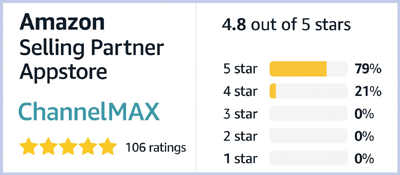
Check ChannelMAX at Amazon Selling Partner Appstore, an application with a 5 star rating.
By ChannelMAX Staff Writer
Nov-2025#12
Amazon is drawing fresh attention to its Seller Challenge benefit for Account Health Assurance sellers through a new announcement on Seller Central titled “Seller Challenge launches for Account Health Assurance.” The feature is already live for eligible sellers and is designed to give them a structured, fast-track way to request a second review of certain listing-level enforcement decisions after they have used the standard appeal routes.
What is Seller Challenge under Account Health Assurance
Seller Challenge is an added review path that sits on top of Amazon’s existing appeal process. It is available only to sellers enrolled in the Account Health Assurance (AHA) program, which protects qualifying accounts from sudden deactivation as long as they engage promptly to resolve issues.
When a listing is deactivated or flagged for certain policy reasons, a seller must first go through the normal appeal steps. If those attempts fail and the case qualifies, the seller can trigger a Seller Challenge from within Seller Central. This sends the enforcement decision for an enhanced review by a dedicated Amazon team.
How the three-challenge limit works
Under the current design, each eligible account receives three Seller Challenge opportunities in every 180-day period. These are sometimes described as “slots” or “chances” in community discussions.
Key points on how these slots work:
• You can use Seller Challenge only on specific listing-level enforcement actions, not on broad account-level issues.
• You get three challenge slots per 180 days.
• If a challenge is successful and Amazon overturns the enforcement, that slot becomes available again.
• If a challenge is denied, the used slot replenishes after six months.
Amazon says its trained teams aim to deliver a decision within about 48 hours, which is much faster than many standard appeals and escalations that can drag on for days or weeks.
Where to find Seller Challenge in Seller Central
The latest announcement makes clear that the update has been communicated through the Seller Central interface itself. Inside Seller Central, eligible sellers will see Seller Challenge in the Product Policy Compliance section of the Account Health area when a particular enforcement qualifies for this path.
In practice, the flow usually looks like this:
i) The seller receives a listing-level enforcement, such as a suspected policy violation.
ii) The seller submits one or more standard appeals and receives decisions.
iii) If the case remains unresolved and is eligible, a Seller Challenge option appears alongside the enforcement notice under Product Policy Compliance.
iv) The seller submits a fresh, more detailed dossier using the Seller Challenge form.
Importantly, if a listing is deactivated when you start a challenge, it normally stays deactivated during the review, so sellers should weigh the impact on sales before using a slot.
Who can use Seller Challenge
Seller Challenge is tied directly to the Account Health Assurance program. Only AHA-enrolled sellers can use it, and loss of AHA status also means loss of access to any unused challenges until eligibility is restored.
AHA itself is aimed at sellers who keep a consistently strong Account Health Rating and respond to issues within Amazon’s timelines. It offers added protection against sudden account deactivation, and Seller Challenge extends that philosophy to individual listing decisions.
Because program rollouts can differ by marketplace, sellers should check their local Seller Central help pages and Account Health dashboard to confirm whether both AHA and Seller Challenge are available on their region’s site.
For sellers, the biggest change is that they now have a formal, time-bound way to ask Amazon for another look at a disputed enforcement after standard appeals have stalled. This can be crucial when a high-volume or seasonal ASIN is taken down just before a peak sales period.
How to check if you are eligible
Amazon’s own guidance says sellers should first confirm whether they are enrolled in Account Health Assurance. To do this, open the Account Health dashboard in Seller Central and look for an Account Health Assurance banner near the top right of the screen.
If the banner is not visible, you may not yet be eligible for AHA or the program may not be available in your marketplace. In that case, you will not see Seller Challenge options either.
How to prepare a strong Seller Challenge submission
Although Seller Challenge is an extra review path, it does not relax policy requirements. Experts who have studied the program stress that Amazon still expects clear documentation and strong evidence.
Seller Challenge is an existing but still relatively new benefit inside Amazon’s wider Account Health framework. By highlighting it again on Seller Central, Amazon is signaling that it wants Account Health Assurance sellers to use this structured path when normal appeals do not resolve listing-level enforcement decisions.
Used wisely, the feature can provide sellers with a faster, clearer route to overturn unfair or mistaken actions, while still keeping strong evidence and policy compliance at the center of every case. If AHA-eligible sellers take time now to understand how Seller Challenge works, both they and Amazon shoppers stand to gain from more accurate, more trusted listings across the marketplace.
Also Read: Amazon extends return window for holiday purchases until January 31
Disclaimer:
Amazon is the registered trademark of the e-commerce brand.
About ChannelMAX.NET:
ChannelMAX offers Amazon Repricer that runs on the latest AI Repricing agents to do Amazon Pricing Management or Amazon Repricing. Based on Amazon SP API, the repricing engine or repricer runs 24/7 and efficiently manages Amazon prices to maximize your BuyBox with profit optimization. Established in 2005, ChannelMAX has been integrated with Amazon technology since 2007, helping thousands of third-party sellers on various eCommerce platforms. Some of the eCommerce platforms, aka marketplaces, supported by ChannelMAX.NET, are Amazon, Walmart, eBay, and Shopify. Some of ChannelMAX key offerings include ChannelMAX Amazon Repricer, 2ndly, ChannelMAX Amazon FBA Audits and FBA Refunds management, an offering for managing Amazon FBA Refunds Reimbursement management for lost or damaged or misplaced inventory for which Amazon is responsible and for which sellers deserve appropriate credit reimbursement from Amazon. ChannelMAX Services offer Remote (aka Virtual) Full-Time eCommerce Assistant to help 3P sellers run their day-today business.
Check ChannelMAX at Amazon Selling Partner Appstore, an application with a 5 star rating.