Amazon’s 2027 US fee update raises FBA costs and reshapes inventory planning

Most changes begin January 15, while new storage and low-inventory rules take effect February 1, giving sellers time to review pricing, replenishment, and margins
By ChannelMAX Staff Writer
Nov-2026#03
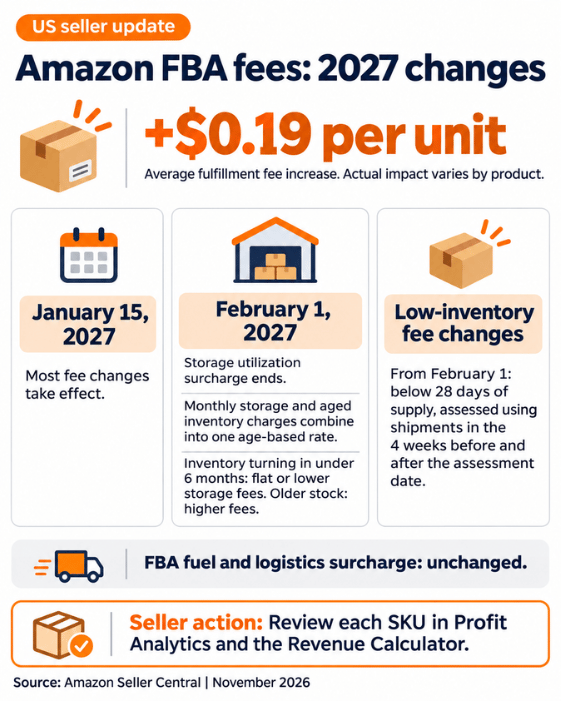
US Amazon sellers face fresh cost calculations for 2027, with Fulfillment by Amazon fulfillment fees set to rise by an average of $0.19 per unit. Changes to storage charges and inventory assessments will also affect how sellers manage stock and protect profitability.
The update, published on Seller Central and detailed in Amazon’s November 5 announcement, says most changes will take effect on January 15, 2027. Storage and low-inventory fee changes will follow on February 1. Sellers can use the advance notice to identify affected products and adjust their budgets before the new rates begin.
Also Read: Amazon Extends Black Friday Cyber Monday Deal Deadline to November 13
Average increase does not tell every seller’s story
Amazon says the average $0.19 fulfillment fee increase represents approximately 0.8% of the average item’s selling price. That figure is not a uniform percentage increase in FBA fees. The actual impact will depend on a product’s size, price, and other characteristics. Some products will attract higher charges, while others will see reductions.
For sellers, this makes product-level calculations essential. Applying an extra $0.19 across an entire catalog could overstate costs for some items and underestimate them for others.
Standard-size products face different increases
Amazon’s detailed fulfillment guidance identifies different average increases across price and size groups. For products priced between $10 and $50, small standard-size fulfillment fees will increase by an average of $0.40 per unit. Large standard-size fees will rise by an average of $0.12.
For products priced above $50, the average increase will be $0.70 for small standard-size items and $0.47 for large standard-size items. For products priced below $10, small standard-size fees will increase by an average of $0.20 per unit. Large standard-size non-apparel fees will remain unchanged, while apparel fees will increase by an average of $0.08.
These are average changes rather than exact charges for individual products. Sellers should check the applicable rate card before changing prices. Low-price FBA eligibility will also narrow. Categories losing eligibility include Automotive and Powersports, Compact Appliances, Computers, Musical Instruments and AV Production, and specified media categories. Affected products will use the rates for items priced between $10 and $50.
Storage fees move to an age-based structure
From February 1, Amazon will eliminate the storage utilization surcharge. It will also combine monthly storage charges and the aged inventory surcharge into a single, age-based storage rate. According to Amazon, inventory that turns over in less than six months will face unchanged or lower storage fees. Older inventory will attract higher charges.
The removal of the separate aged inventory surcharge does not mean that holding older stock becomes cheaper. Inventory age will remain a cost factor within the new structure. Sellers should review slow-moving products before February and compare the likely cost of continued storage with discounts, removal, or other inventory reduction options. Decisions should account for expected demand and the costs of each alternative.
Low-inventory fee will consider demand before and after assessment
Amazon is changing how it determines whether inventory levels are too low. The current approach uses trailing 30-day and 90-day sales. From February 1, the assessment will consider actual shipments during both the four weeks before and the four weeks after the assessment date. The fee will apply when inventory falls below 28 days of supply under the revised rules.
Amazon says the additional demand check should reduce charges triggered by temporary sales spikes, products approaching the end of their selling season, or products being discontinued.
For sellers, the practical benefit is an assessment intended to better reflect sustained demand. However, the fee is continuing, so replenishment planning remains important. Sellers should factor supplier lead times, transit delays, and fulfillment-center receiving time into their stock decisions.
Fuel surcharge stays in place
The FBA fuel and logistics surcharge remains unchanged. Amazon attributes its continuation to elevated costs, particularly fuel and long-distance trucking. Amazon’s detailed guidance identifies the surcharge as 3.5% of fulfillment fees. Sellers should keep it in their calculations alongside the applicable base rate.
The holiday peak fulfillment fee period ends January 14, 2027, with updated non-peak rates taking effect the following day. Sellers comparing December and January costs should distinguish the end of peak pricing from the annual fee changes.
Promotions and warehousing also need attention
The broader fee schedule introduces a $5 upfront fee and a 2% variable fee, capped at $2,000, for Buy X, Get Y promotions. Monthly promotion billing begins in February 2027. Sellers should include these charges when calculating campaign profitability.
For Amazon Warehousing and Distribution, processing fees become $1.55 per box and transportation fees $1.58 per cubic foot from February 1. A 40% inbound processing discount will apply to single-SKU pallets. The fuel surcharge will also extend to AWD transportation.
From March 1, AWD inventory stored for more than 12 months will be charged at 2.5 times the standard storage rate. Sellers using AWD should therefore review upstream inventory as well as stock already held in FBA.
How sellers can prepare
The new Fee Change Comparison dashboard in Profit Analytics provides account-level and product-level views of the changes. Amazon also directs sellers to the Revenue Calculator to model fee scenarios. A useful starting point is to review high-volume products, low-margin items, and aging inventory. These are the areas where a small per-unit change or a higher storage rate may have the greatest business impact.
Sellers should then update their profitability calculations to include product costs, referral fees, fulfillment, surcharges, storage, advertising, returns, and promotion expenses. Any pricing or repricing rules should reflect the revised costs while accounting for competition and customer demand.
For illustration, an additional $0.40 per unit on a product selling 1,000 units a month would add $400 in monthly fulfillment costs, before other changes. This is a planning example, not an estimate for every seller.
Using the advance notice to protect margins
The 2027 update combines higher fulfillment charges for many products with changes intended to make storage and inventory assessments more predictable. The outcome will depend on each seller’s product mix, turnover, and use of Amazon’s services.
Sellers who review their catalogs before January 15 and reassess inventory before February 1 will be better placed to identify savings, budget for increases, and make informed pricing decisions. Calculating the impact product by product will provide a more useful picture than relying on the headline average.
Also Read: Amazon extends international FBA shipment deadlines for peak season
Disclaimer:
Amazon is the registered trademark of the e-commerce brand.
About ChannelMAX.NET:
ChannelMAX offers Amazon Repricer that runs on the latest AI Repricing algorithm to do Amazon Pricing Management or Amazon Repricing. Based on Amazon SP API, the repricing engine or repricer runs 24/7 and efficiently manages Amazon prices to maximize your BuyBox with profit optimization. Established in 2005, ChannelMAX has been integrated with Amazon technology since 2007, helping thousands of third-party sellers on various eCommerce platforms. Some of the eCommerce platforms, aka marketplaces, supported by ChannelMAX.NET, are Amazon, Walmart, eBay, and Shopify. Some of ChannelMAX key offerings include ChannelMAX Amazon Repricer, 2ndly, ChannelMAX Amazon FBA Audits and FBA Refunds management, an offering for managing Amazon FBA Refunds Reimbursement management for lost or damaged or misplaced inventory for which Amazon is responsible and for which sellers deserve appropriate credit reimbursement from Amazon. ChannelMAX Services offer Remote (aka Virtual) Full-Time eCommerce Assistant to help 3P sellers run their daytoday business.
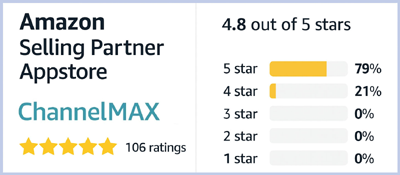
Check ChannelMAX at Amazon Selling Partner Appstore, an application with a 5 star rating.
By ChannelMAX Staff Writer
Nov-2026#03
US Amazon sellers face fresh cost calculations for 2027, with Fulfillment by Amazon fulfillment fees set to rise by an average of $0.19 per unit. Changes to storage charges and inventory assessments will also affect how sellers manage stock and protect profitability.
The update, published on Seller Central and detailed in Amazon’s November 5 announcement, says most changes will take effect on January 15, 2027. Storage and low-inventory fee changes will follow on February 1. Sellers can use the advance notice to identify affected products and adjust their budgets before the new rates begin.
Also Read: Amazon Extends Black Friday Cyber Monday Deal Deadline to November 13
Average increase does not tell every seller’s story
Amazon says the average $0.19 fulfillment fee increase represents approximately 0.8% of the average item’s selling price. That figure is not a uniform percentage increase in FBA fees. The actual impact will depend on a product’s size, price, and other characteristics. Some products will attract higher charges, while others will see reductions.
For sellers, this makes product-level calculations essential. Applying an extra $0.19 across an entire catalog could overstate costs for some items and underestimate them for others.
Standard-size products face different increases
Amazon’s detailed fulfillment guidance identifies different average increases across price and size groups. For products priced between $10 and $50, small standard-size fulfillment fees will increase by an average of $0.40 per unit. Large standard-size fees will rise by an average of $0.12.
For products priced above $50, the average increase will be $0.70 for small standard-size items and $0.47 for large standard-size items. For products priced below $10, small standard-size fees will increase by an average of $0.20 per unit. Large standard-size non-apparel fees will remain unchanged, while apparel fees will increase by an average of $0.08.
These are average changes rather than exact charges for individual products. Sellers should check the applicable rate card before changing prices. Low-price FBA eligibility will also narrow. Categories losing eligibility include Automotive and Powersports, Compact Appliances, Computers, Musical Instruments and AV Production, and specified media categories. Affected products will use the rates for items priced between $10 and $50.
Storage fees move to an age-based structure
From February 1, Amazon will eliminate the storage utilization surcharge. It will also combine monthly storage charges and the aged inventory surcharge into a single, age-based storage rate. According to Amazon, inventory that turns over in less than six months will face unchanged or lower storage fees. Older inventory will attract higher charges.
The removal of the separate aged inventory surcharge does not mean that holding older stock becomes cheaper. Inventory age will remain a cost factor within the new structure. Sellers should review slow-moving products before February and compare the likely cost of continued storage with discounts, removal, or other inventory reduction options. Decisions should account for expected demand and the costs of each alternative.
Low-inventory fee will consider demand before and after assessment
Amazon is changing how it determines whether inventory levels are too low. The current approach uses trailing 30-day and 90-day sales. From February 1, the assessment will consider actual shipments during both the four weeks before and the four weeks after the assessment date. The fee will apply when inventory falls below 28 days of supply under the revised rules.
Amazon says the additional demand check should reduce charges triggered by temporary sales spikes, products approaching the end of their selling season, or products being discontinued.
For sellers, the practical benefit is an assessment intended to better reflect sustained demand. However, the fee is continuing, so replenishment planning remains important. Sellers should factor supplier lead times, transit delays, and fulfillment-center receiving time into their stock decisions.
Fuel surcharge stays in place
The FBA fuel and logistics surcharge remains unchanged. Amazon attributes its continuation to elevated costs, particularly fuel and long-distance trucking. Amazon’s detailed guidance identifies the surcharge as 3.5% of fulfillment fees. Sellers should keep it in their calculations alongside the applicable base rate.
The holiday peak fulfillment fee period ends January 14, 2027, with updated non-peak rates taking effect the following day. Sellers comparing December and January costs should distinguish the end of peak pricing from the annual fee changes.
Promotions and warehousing also need attention
The broader fee schedule introduces a $5 upfront fee and a 2% variable fee, capped at $2,000, for Buy X, Get Y promotions. Monthly promotion billing begins in February 2027. Sellers should include these charges when calculating campaign profitability.
For Amazon Warehousing and Distribution, processing fees become $1.55 per box and transportation fees $1.58 per cubic foot from February 1. A 40% inbound processing discount will apply to single-SKU pallets. The fuel surcharge will also extend to AWD transportation.
From March 1, AWD inventory stored for more than 12 months will be charged at 2.5 times the standard storage rate. Sellers using AWD should therefore review upstream inventory as well as stock already held in FBA.
How sellers can prepare
The new Fee Change Comparison dashboard in Profit Analytics provides account-level and product-level views of the changes. Amazon also directs sellers to the Revenue Calculator to model fee scenarios. A useful starting point is to review high-volume products, low-margin items, and aging inventory. These are the areas where a small per-unit change or a higher storage rate may have the greatest business impact.
Sellers should then update their profitability calculations to include product costs, referral fees, fulfillment, surcharges, storage, advertising, returns, and promotion expenses. Any pricing or repricing rules should reflect the revised costs while accounting for competition and customer demand.
For illustration, an additional $0.40 per unit on a product selling 1,000 units a month would add $400 in monthly fulfillment costs, before other changes. This is a planning example, not an estimate for every seller.
Using the advance notice to protect margins
The 2027 update combines higher fulfillment charges for many products with changes intended to make storage and inventory assessments more predictable. The outcome will depend on each seller’s product mix, turnover, and use of Amazon’s services.
Sellers who review their catalogs before January 15 and reassess inventory before February 1 will be better placed to identify savings, budget for increases, and make informed pricing decisions. Calculating the impact product by product will provide a more useful picture than relying on the headline average.
Also Read: Amazon extends international FBA shipment deadlines for peak season
Disclaimer:
Amazon is the registered trademark of the e-commerce brand.
About ChannelMAX.NET:
ChannelMAX offers Amazon Repricer that runs on the latest AI Repricing algorithm to do Amazon Pricing Management or Amazon Repricing. Based on Amazon SP API, the repricing engine or repricer runs 24/7 and efficiently manages Amazon prices to maximize your BuyBox with profit optimization. Established in 2005, ChannelMAX has been integrated with Amazon technology since 2007, helping thousands of third-party sellers on various eCommerce platforms. Some of the eCommerce platforms, aka marketplaces, supported by ChannelMAX.NET, are Amazon, Walmart, eBay, and Shopify. Some of ChannelMAX key offerings include ChannelMAX Amazon Repricer, 2ndly, ChannelMAX Amazon FBA Audits and FBA Refunds management, an offering for managing Amazon FBA Refunds Reimbursement management for lost or damaged or misplaced inventory for which Amazon is responsible and for which sellers deserve appropriate credit reimbursement from Amazon. ChannelMAX Services offer Remote (aka Virtual) Full-Time eCommerce Assistant to help 3P sellers run their daytoday business.
Check ChannelMAX at Amazon Selling Partner Appstore, an application with a 5 star rating.