Amazon Introduces Bulk TRF Submission to Simplify Product Compliance Testing
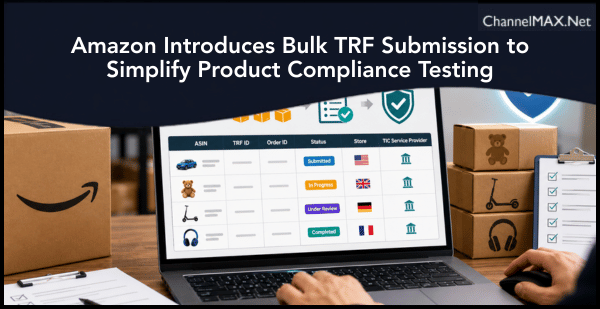
New Seller Central features allow sellers to submit test requests for multiple flagged products, monitor requests across stores, and manage compliance testing from a centralized dashboard
By ChannelMAX Staff Writer
Aug-2026#11
Product compliance can become time-consuming for Amazon sellers when several ASINs require third-party testing at the same time. A new Seller Central update aims to reduce that workload by allowing eligible sellers to submit Test Request Forms, known as TRFs, in bulk instead of processing every affected product separately.
Effective July 24, 2026, the change also gives sellers better visibility into test requests across multiple Amazon stores within the same region. The update is particularly useful for businesses managing larger catalogs or several products subject to the same compliance policy.
The update was published on Amazon US Seller Central under the title “Save time with bulk TRF submission.”
What is changing with TRF submissions?
Before this update, sellers could submit only one TRF at a time for each ASIN and each store. That could mean repeating similar steps several times when multiple products were flagged for testing, inspection, or certification.
The new functionality is designed to consolidate much of that work. Amazon has introduced three key improvements: bulk TRF submission, cross-store compliance visibility, and a centralized dashboard for managing test requests.
Also Read: Amazon Launches Prime Air Drone Delivery in UK, Offering Deliveries Within 60 Minutes
Submit TRFs for multiple products at once
The biggest change is the ability to submit test requests in bulk. Sellers can now submit requests for multiple flagged products covered by the same policy instead of completing the same process separately for each eligible ASIN.
This could provide a significant time-saving advantage for sellers with large catalogs.
For example, if several products are flagged under the same applicable compliance policy, an eligible seller can process those testing requests together rather than working through each ASIN individually.
However, sellers should remember that the bulk feature does not mean unrelated compliance requirements can necessarily be grouped together. The Seller Central announcement specifically refers to multiple flagged products within a policy.
Better visibility across Amazon stores
The second major improvement is cross-store compliance visibility. Sellers operating across multiple Amazon stores within a region can now view the status of their test requests across their stores without having to repeatedly switch between them.
This is particularly useful for brands and larger businesses that sell the same or related products through several Amazon stores.
It can also help compliance teams maintain a more complete view of pending testing requests and reduce the possibility of overlooking an affected product in another store.
Centralized dashboard makes TRF tracking easier
Amazon has also introduced a centralized dashboard for managing test requests. Sellers can use several filters to locate and track individual requests, including:
i) ASIN
ii) TRF ID
iii) Order ID
iv) Status
v) Store
vi) TIC provider
These search and filtering options can be especially useful when a seller has many compliance cases in progress.
Instead of manually checking products one by one, sellers can use the available identifiers and filters to find specific requests and monitor their status.
Who can benefit from the update?
The new functionality is aimed at sellers listing products in categories where Amazon requires third-party testing, inspection, and certification verification. These organizations are commonly referred to as TIC service providers.
Product testing and certification requirements can vary depending on the product, category, applicable policy, and marketplace. Sellers should therefore check the compliance requirements displayed in Seller Central for their individual ASINs rather than assuming that the same requirement applies to every product in a category.
The bulk TRF feature could be particularly valuable for:
i) Sellers managing a large number of ASINs
ii) Brands with several products subject to the same compliance policy
iii) Businesses operating across multiple Amazon stores
iv) Compliance teams handling numerous testing requests
v) Sellers regularly working with third-party TIC providers
How TIC verification fits into Amazon compliance
Third-party testing and certification are important parts of Amazon's product compliance system for certain regulated or safety-sensitive products. Depending on the applicable requirement, sellers may be directed to work with an approved third-party testing, inspection, and certification provider.
The provider may need to verify that a product meets relevant safety, testing, or certification requirements before the compliance process can be completed. The exact procedure can vary. Sellers should carefully follow the instructions shown in Seller Central and those provided by the selected TIC service provider.
Importantly, the new bulk TRF functionality changes how sellers can initiate and manage eligible testing requests. It does not remove the underlying testing, inspection, certification, or documentation requirements applicable to a product.
Why the change matters for sellers
The main advantage is efficiency. Consider a seller with 20 products flagged under the same compliance policy. Under the previous process, managing individual TRF submissions for each eligible ASIN and store could involve considerable repetitive work.
Bulk submission can reduce those repeated steps.
Cross-store visibility provides another advantage. A seller managing several stores can see test-request statuses more easily without continuously moving between individual store views. The centralized dashboard then brings those requests into a more manageable workflow.
Together, the three changes can help sellers spend less time on administrative tasks and more time addressing the actual compliance requirements.
What sellers should do
Sellers dealing with product compliance requests should first identify all affected ASINs and review the policy associated with each one. If several products have been flagged under the same policy, sellers should check whether they are eligible for bulk TRF submission.
They should also use the centralized dashboard to monitor open requests and identify cases that still require action.
Keeping records of ASINs, TRF IDs, Order IDs, providers, and request statuses can also help businesses maintain an internal compliance trail, particularly when several employees or service providers are involved.
Sellers should continue to pay close attention to any deadlines displayed in Seller Central. A more efficient submission system does not change the importance of responding to compliance requirements on time.
Do not treat TRF submission as completion of compliance
One distinction is important for sellers. Submitting a Test Request Form should not be confused with completing the entire product compliance process.
A TRF initiates or supports the applicable testing workflow. Depending on the requirement, further action may still be necessary with the TIC provider.
This could include providing product details, arranging product samples, completing testing, paying service-provider fees, or responding to additional requests.
Sellers should therefore continue monitoring both their Seller Central compliance status and communications from their selected TIC provider after submitting a TRF.
Review compliance status regularly
Amazon sellers, particularly those with large catalogs, should make compliance monitoring part of their regular account-management routine. A useful approach is to periodically review affected ASINs, pending requests, completed cases, and upcoming compliance deadlines.
The new dashboard can make that process easier because sellers can filter requests by ASIN, TRF ID, Order ID, status, store, or provider.
For teams managing many products, this also creates an opportunity to establish a more organized internal workflow. One team member can monitor new compliance issues while another coordinates testing requirements with TIC providers.
A useful time-saving upgrade for compliance management
Amazon's bulk TRF submission feature is more than a small interface change for sellers that regularly deal with product testing. It addresses one of the repetitive parts of managing compliance across multiple products and stores.
Bulk submissions can reduce repeated work, cross-store visibility can make outstanding requests easier to identify, and the centralized dashboard provides sellers with a clearer way to track multiple testing cases.
Sellers with products subject to third-party testing, inspection, and certification requirements should review the new functionality in Seller Central and determine whether their affected ASINs can be managed through the bulk workflow.
For businesses handling numerous compliance requests, using these tools early and maintaining regular oversight of pending TRFs could save administrative time while helping them stay on top of product compliance obligations.
Also Read: Amazon urges sellers to optimize listings with built-in tools to improve visibility and sales
Disclaimer:
Amazon is the registered trademark of the company.
About ChannelMAX.NET:
ChannelMAX offers Amazon Repricer that runs on the latest AI Repricing algorithm to do Amazon Pricing Management or Amazon Repricing. Based on Amazon SP API, the repricing engine or repricer runs 24/7 and efficiently manages Amazon prices to maximize your BuyBox with profit optimization. Established in 2005, ChannelMAX has been integrated with Amazon technology since 2007, helping thousands of third-party sellers on various eCommerce platforms. Some of the eCommerce platforms, aka marketplaces, supported by ChannelMAX.NET, are Amazon, Walmart, eBay, and Shopify. Some of ChannelMAX key offerings include ChannelMAX Amazon Repricer, 2ndly, ChannelMAX Amazon FBA Audits and FBA Refunds management, an offering for managing Amazon FBA Refunds Reimbursement management for lost or damaged or misplaced inventory for which Amazon is responsible and for which sellers deserve appropriate credit reimbursement from Amazon. ChannelMAX Services offer Remote (aka Virtual) Full-Time eCommerce Assistant to help 3P sellers run their daytoday business.
Check ChannelMAX at Amazon Selling Partner Appstore, an application with a 5 star rating.
By ChannelMAX Staff Writer
Aug-2026#11
Product compliance can become time-consuming for Amazon sellers when several ASINs require third-party testing at the same time. A new Seller Central update aims to reduce that workload by allowing eligible sellers to submit Test Request Forms, known as TRFs, in bulk instead of processing every affected product separately.
Effective July 24, 2026, the change also gives sellers better visibility into test requests across multiple Amazon stores within the same region. The update is particularly useful for businesses managing larger catalogs or several products subject to the same compliance policy.
The update was published on Amazon US Seller Central under the title “Save time with bulk TRF submission.”
What is changing with TRF submissions?
Before this update, sellers could submit only one TRF at a time for each ASIN and each store. That could mean repeating similar steps several times when multiple products were flagged for testing, inspection, or certification.
The new functionality is designed to consolidate much of that work. Amazon has introduced three key improvements: bulk TRF submission, cross-store compliance visibility, and a centralized dashboard for managing test requests.
Also Read: Amazon Launches Prime Air Drone Delivery in UK, Offering Deliveries Within 60 Minutes
Submit TRFs for multiple products at once
The biggest change is the ability to submit test requests in bulk. Sellers can now submit requests for multiple flagged products covered by the same policy instead of completing the same process separately for each eligible ASIN.
This could provide a significant time-saving advantage for sellers with large catalogs.
For example, if several products are flagged under the same applicable compliance policy, an eligible seller can process those testing requests together rather than working through each ASIN individually.
However, sellers should remember that the bulk feature does not mean unrelated compliance requirements can necessarily be grouped together. The Seller Central announcement specifically refers to multiple flagged products within a policy.
Better visibility across Amazon stores
The second major improvement is cross-store compliance visibility. Sellers operating across multiple Amazon stores within a region can now view the status of their test requests across their stores without having to repeatedly switch between them.
This is particularly useful for brands and larger businesses that sell the same or related products through several Amazon stores.
It can also help compliance teams maintain a more complete view of pending testing requests and reduce the possibility of overlooking an affected product in another store.
Centralized dashboard makes TRF tracking easier
Amazon has also introduced a centralized dashboard for managing test requests. Sellers can use several filters to locate and track individual requests, including:
i) ASIN
ii) TRF ID
iii) Order ID
iv) Status
v) Store
vi) TIC provider
These search and filtering options can be especially useful when a seller has many compliance cases in progress.
Instead of manually checking products one by one, sellers can use the available identifiers and filters to find specific requests and monitor their status.
Who can benefit from the update?
The new functionality is aimed at sellers listing products in categories where Amazon requires third-party testing, inspection, and certification verification. These organizations are commonly referred to as TIC service providers.
Product testing and certification requirements can vary depending on the product, category, applicable policy, and marketplace. Sellers should therefore check the compliance requirements displayed in Seller Central for their individual ASINs rather than assuming that the same requirement applies to every product in a category.
The bulk TRF feature could be particularly valuable for:
i) Sellers managing a large number of ASINs
ii) Brands with several products subject to the same compliance policy
iii) Businesses operating across multiple Amazon stores
iv) Compliance teams handling numerous testing requests
v) Sellers regularly working with third-party TIC providers
How TIC verification fits into Amazon compliance
Third-party testing and certification are important parts of Amazon's product compliance system for certain regulated or safety-sensitive products. Depending on the applicable requirement, sellers may be directed to work with an approved third-party testing, inspection, and certification provider.
The provider may need to verify that a product meets relevant safety, testing, or certification requirements before the compliance process can be completed. The exact procedure can vary. Sellers should carefully follow the instructions shown in Seller Central and those provided by the selected TIC service provider.
Importantly, the new bulk TRF functionality changes how sellers can initiate and manage eligible testing requests. It does not remove the underlying testing, inspection, certification, or documentation requirements applicable to a product.
Why the change matters for sellers
The main advantage is efficiency. Consider a seller with 20 products flagged under the same compliance policy. Under the previous process, managing individual TRF submissions for each eligible ASIN and store could involve considerable repetitive work.
Bulk submission can reduce those repeated steps.
Cross-store visibility provides another advantage. A seller managing several stores can see test-request statuses more easily without continuously moving between individual store views. The centralized dashboard then brings those requests into a more manageable workflow.
Together, the three changes can help sellers spend less time on administrative tasks and more time addressing the actual compliance requirements.
What sellers should do
Sellers dealing with product compliance requests should first identify all affected ASINs and review the policy associated with each one. If several products have been flagged under the same policy, sellers should check whether they are eligible for bulk TRF submission.
They should also use the centralized dashboard to monitor open requests and identify cases that still require action.
Keeping records of ASINs, TRF IDs, Order IDs, providers, and request statuses can also help businesses maintain an internal compliance trail, particularly when several employees or service providers are involved.
Sellers should continue to pay close attention to any deadlines displayed in Seller Central. A more efficient submission system does not change the importance of responding to compliance requirements on time.
Do not treat TRF submission as completion of compliance
One distinction is important for sellers. Submitting a Test Request Form should not be confused with completing the entire product compliance process.
A TRF initiates or supports the applicable testing workflow. Depending on the requirement, further action may still be necessary with the TIC provider.
This could include providing product details, arranging product samples, completing testing, paying service-provider fees, or responding to additional requests.
Sellers should therefore continue monitoring both their Seller Central compliance status and communications from their selected TIC provider after submitting a TRF.
Review compliance status regularly
Amazon sellers, particularly those with large catalogs, should make compliance monitoring part of their regular account-management routine. A useful approach is to periodically review affected ASINs, pending requests, completed cases, and upcoming compliance deadlines.
The new dashboard can make that process easier because sellers can filter requests by ASIN, TRF ID, Order ID, status, store, or provider.
For teams managing many products, this also creates an opportunity to establish a more organized internal workflow. One team member can monitor new compliance issues while another coordinates testing requirements with TIC providers.
A useful time-saving upgrade for compliance management
Amazon's bulk TRF submission feature is more than a small interface change for sellers that regularly deal with product testing. It addresses one of the repetitive parts of managing compliance across multiple products and stores.
Bulk submissions can reduce repeated work, cross-store visibility can make outstanding requests easier to identify, and the centralized dashboard provides sellers with a clearer way to track multiple testing cases.
Sellers with products subject to third-party testing, inspection, and certification requirements should review the new functionality in Seller Central and determine whether their affected ASINs can be managed through the bulk workflow.
For businesses handling numerous compliance requests, using these tools early and maintaining regular oversight of pending TRFs could save administrative time while helping them stay on top of product compliance obligations.
Also Read: Amazon urges sellers to optimize listings with built-in tools to improve visibility and sales
Disclaimer:
Amazon is the registered trademark of the company.
About ChannelMAX.NET:
ChannelMAX offers Amazon Repricer that runs on the latest AI Repricing algorithm to do Amazon Pricing Management or Amazon Repricing. Based on Amazon SP API, the repricing engine or repricer runs 24/7 and efficiently manages Amazon prices to maximize your BuyBox with profit optimization. Established in 2005, ChannelMAX has been integrated with Amazon technology since 2007, helping thousands of third-party sellers on various eCommerce platforms. Some of the eCommerce platforms, aka marketplaces, supported by ChannelMAX.NET, are Amazon, Walmart, eBay, and Shopify. Some of ChannelMAX key offerings include ChannelMAX Amazon Repricer, 2ndly, ChannelMAX Amazon FBA Audits and FBA Refunds management, an offering for managing Amazon FBA Refunds Reimbursement management for lost or damaged or misplaced inventory for which Amazon is responsible and for which sellers deserve appropriate credit reimbursement from Amazon. ChannelMAX Services offer Remote (aka Virtual) Full-Time eCommerce Assistant to help 3P sellers run their daytoday business.
Check ChannelMAX at Amazon Selling Partner Appstore, an application with a 5 star rating.