Amazon urges sellers to optimize listings with built-in tools to improve visibility and sales

By ChannelMAX Staff Writer
Aug-2026#05
Amazon is encouraging US sellers to make greater use of tools already available within Seller Central to improve product listings and potentially increase sales. In an update titled “Optimize your listings with built-in Seller Central tools,” Amazon highlighted three areas sellers should focus on: testing listing content, understanding how shoppers search for products and improving product images.
The company specifically pointed sellers toward Manage Your Experiments, the Search Query Performance dashboard and Image Manager.
For sellers, the message is important because listing optimization does not have to rely entirely on assumptions or third-party tools. Amazon provides first-party data and testing capabilities that can help sellers understand what shoppers search for and which listing content performs better.
Also Read: Holiday 2026 Planning Begins as Amazon Sets Earlier Deadlines for Peak Season Sellers
Use Manage Your Experiments to test what actually converts
One of the key tools highlighted in the Seller Central announcement is Manage Your Experiments. The tool allows eligible sellers to conduct A/B tests on different versions of product listing content. Rather than changing a listing and simply hoping performance improves, sellers can compare alternatives using actual customer behavior.
Amazon says Manage Your Experiments can be used to test product images, titles, bullet points, descriptions and A+ Content, including Brand Story content. During an experiment, customers viewing the product detail page are randomly divided into groups and shown different versions of the content. Amazon then measures performance using metrics including units sold, sales, conversion rate and units sold per unique visitor.
This gives sellers a clearer picture of which version performs better. Amazon says optimized listing content can help increase sales by up to 20 percent, based on its internal data. However, this should not be interpreted as a guaranteed increase for every seller or ASIN.
Amazon also recommends making the two versions meaningfully different. Testing nearly identical content can make it more difficult to produce useful results.
Who can use Manage Your Experiments?
There are eligibility requirements sellers should keep in mind. According to Amazon, sellers need a Professional selling account and must be a Brand Representative for a brand enrolled in Amazon Brand Registry to access Manage Your Experiments.
Individual products must also meet eligibility requirements. An ASIN generally needs sufficient recent traffic for Amazon to generate meaningful experimental results. Amazon recommends allowing experiments to run until enough data has been collected to produce statistically significant results rather than making decisions based on early performance.
Search Query Performance reveals how shoppers find products
Amazon also highlighted the Search Query Performance dashboard as a valuable source of keyword intelligence. Available through Amazon Brand Analytics to eligible registered brands, the dashboard helps sellers understand the search queries customers use to discover their products.
Sellers can examine metrics including search query volume, impressions, clicks, cart adds and purchases. They can also evaluate their brand’s share of performance for individual queries.
This makes the dashboard useful for more than simply finding popular keywords. For example, a seller may discover that a product receives strong impressions for a particular query but relatively few clicks. That could indicate the listing needs a more compelling title, image or value proposition.
If shoppers are clicking but not adding the product to their carts, sellers may need to examine whether the detail page clearly communicates the product’s benefits, specifications and suitability.
Use customer search data to strengthen listings
Amazon’s Seller Central update recommends incorporating relevant search insights into titles, bullet points and backend keywords. The important point for sellers is relevance. Instead of adding keywords simply because they have search volume, sellers can use Search Query Performance data to identify terminology customers actually associate with their products.
Search Query Performance can be viewed at the brand or ASIN level, allowing sellers to investigate individual products and identify potentially valuable search terms. Amazon also offers other Brand Analytics resources, including Search Catalog Performance and Top Search Terms, which can provide additional insights into product discoverability and customer behavior.
Together, these tools can help sellers build a more data-driven Amazon SEO strategy.
Improve product images through Image Manager
The third area emphasized in the Seller Central update is product imagery. Amazon recommends that sellers make full use of available image slots and upload high-resolution images of at least 1,000 pixels to support the zoom experience.
Beyond the main product image, sellers should consider using additional images to answer questions customers might otherwise have before purchasing. Depending on the product, these could include infographics explaining important features and benefits, size guides, dimensions, comparison graphics and lifestyle images demonstrating how the product is used.
Amazon particularly highlighted the importance of the second product image, noting in its Seller Central announcement that it can appear alongside the main image in mobile search results.
That makes the second image more strategically important than simply treating it as another gallery image. Sellers should consider using it to communicate an important product benefit or visual detail while ensuring all images comply with Amazon’s applicable product image requirements.
A practical optimization workflow for sellers
Sellers can combine the three tools instead of treating them as separate listing-management features. A useful starting point is Search Query Performance. Sellers can identify important queries associated with an ASIN and examine where customers may be dropping out between impressions, clicks, cart additions and purchases.
They can then use those insights to revise listing elements such as titles, bullet points, images and A+ Content.
Where eligible, Manage Your Experiments can then be used to test significant changes against existing content rather than immediately replacing the current version.
Finally, Image Manager can help sellers maintain and improve the visual content associated with their listings. This creates a continuous optimization cycle: analyze customer behavior, identify an opportunity, create an improved version, test the change and use performance data to decide what stays.
Focus on conversion, not keywords alone
The broader takeaway from Amazon’s Seller Central update is that listing optimization should extend beyond keyword placement. Keywords can help customers discover a product, but the detail page still needs to persuade those shoppers to buy.
Images, titles, bullet points, product information and A+ Content should therefore work together to answer customer questions and communicate the product’s most important benefits. Sellers should also avoid making several unmeasured changes at once when they want to understand what caused an improvement or decline in performance.
For eligible ASINs, structured experiments provide a better way to determine whether a change actually improves customer response.
What sellers should do now
Sellers may want to begin by reviewing their most important ASINs rather than attempting to overhaul an entire catalog. They can check Search Query Performance for customer search behavior, review existing image galleries for missing information and identify listings eligible for Manage Your Experiments.
High-traffic ASINs with weaker-than-expected conversion rates may be particularly useful candidates for optimization because even relatively small improvements in conversion can have a meaningful impact at scale.
The Seller Central update ultimately reinforces a data-driven approach to listing optimization. Instead of relying only on intuition when selecting keywords, images or listing copy, eligible Amazon sellers can use first-party customer search data and controlled experiments to make more informed decisions.
Used together, Manage Your Experiments, Search Query Performance and Image Manager can help sellers understand how shoppers discover products, determine which content performs better and build stronger product detail pages.
For sellers preparing for competitive sales periods or looking to improve established ASINs, regularly reviewing these built-in Seller Central tools could turn listing optimization from a one-time exercise into an ongoing process for improving discoverability, conversion and sales.
Also Read: Labor Day Sale 2026: Amazon urges US sellers to clear excess inventory and launch deals before Q4
Disclaimer:
Amazon is the registered trademark of the company.
About ChannelMAX.NET
ChannelMAX offers an Amazon Repricer powered by the latest AI repricing algorithm for Amazon pricing management. Built on the Amazon SP-API, the repricing engine operates 24/7 to manage prices efficiently, increase Buy Box opportunities, and optimize profitability.
Established in 2005 and integrated with Amazon technology since 2007, ChannelMAX has helped thousands of third-party sellers across marketplaces and eCommerce platforms, including Amazon, Walmart, eBay, and Shopify.
Key offerings include the ChannelMAX Amazon Repricer , Amazon FBA audits, and FBA Refunds management . The FBA reimbursement service helps sellers identify and recover eligible credits for inventory lost, damaged, or misplaced while under Amazon’s responsibility.
ChannelMAX Services also provides remote, full-time eCommerce assistants who help third-party sellers manage their day-to-day business operations.
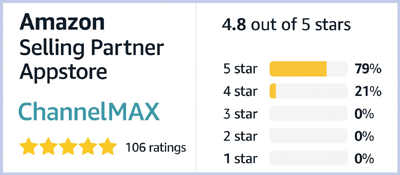
Find ChannelMAX in the Amazon Selling Partner Appstore — a five-star-rated application.