Amazon Launches Standard Ocean Express to Speed Up East Coast FBA Inventory Delivery
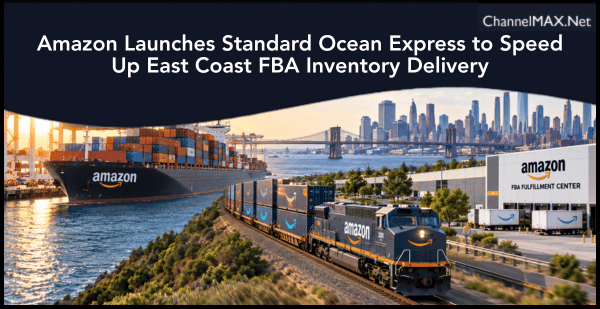
New Amazon Global Logistics option routes Seller Managed Placement shipments through Los Angeles and direct rail to East Coast fulfillment centers
By ChannelMAX Staff Writer
Sept-2026#05
Getting imported inventory into Amazon’s East Coast fulfillment network could become faster for sellers using Amazon Global Logistics. A new shipping option called Standard Ocean Express is now available for Seller Managed Placement bookings, offering improved transit times compared with standard routing.
The service routes eligible ocean shipments through the Port of Los Angeles before moving them by direct rail to Amazon fulfillment centers on the East Coast. Amazon says the faster routing can make inventory available to customers sooner and help sellers reduce the risk of running out of stock during periods of strong demand. The update was published on Seller Central under the title “Get inventory to the East Coast faster with Standard Ocean Express.”
What is Standard Ocean Express?
Standard Ocean Express is a new speed option available through Amazon Global Logistics, commonly known as AGL, for Seller Managed Placement, or SMP, bookings destined for the East Coast region. Rather than requiring sellers to adopt a completely new logistics process, the service works within the existing SMP booking workflow.
Amazon says sellers do not need additional registration or documentation to use the new speed option. The main difference is the transportation route. Standard Ocean Express moves shipments through Los Angeles and then uses direct rail transportation to Amazon’s East Coast fulfillment centers.
For sellers importing products into the United States, this provides another way to balance transportation speed and ocean freight costs when replenishing inventory in the eastern part of the country.
Also Read: Amazon Tightens Seller Insurance Rules From November 2, Adds Mandatory Coverage for Safety-Sensitive Products
Faster inventory movement to the East Coast
The most important benefit is improved transit time compared with Amazon’s standard routing. Long replenishment cycles can create problems for sellers, particularly when inventory is being shipped internationally. Delays can result in products going out of stock before replacement units reach fulfillment centers.
Amazon says Standard Ocean Express can get inventory to East Coast fulfillment centers faster, allowing those units to become available to customers sooner. This could be particularly useful before major sales periods or seasonal demand spikes when sellers need tighter control over replenishment schedules.
Routes through Los Angeles with direct rail connection
The logistics model behind Standard Ocean Express is notable. Instead of relying on a conventional ocean route to an East Coast port, shipments are routed through the Port of Los Angeles on the West Coast.
From there, the inventory moves by direct rail to Amazon fulfillment centers on the East Coast. This multimodal ocean and rail approach is designed to provide improved transit times while retaining the cost characteristics of ocean freight. However, sellers should still compare the estimated delivery window shown during booking with other available transportation options before selecting a service.
Rates and delivery estimates shown during booking
Amazon says Standard Ocean Express provides competitive and transparent ocean rates. Pricing is displayed at the point of booking alongside estimated delivery windows. This allows sellers to compare the cost and expected arrival timing before confirming the shipment.
The visibility can be useful for inventory planning because the fastest available logistics option is not necessarily the most economical choice for every shipment. For products with sufficient inventory coverage, standard routing may remain suitable. For ASINs approaching an inventory shortage, the faster Standard Ocean Express option could potentially justify a higher transportation cost if it helps avoid an extended stockout.
No additional setup required
One advantage for existing AGL and SMP users is that Standard Ocean Express does not require a separate onboarding process. Amazon says there is zero additional setup. Sellers do not need new registration or additional documentation to select the service. It is integrated into the existing Seller Managed Placement booking flow.
Sellers that have not previously used Amazon Global Logistics will first need to visit the AGL program portal and set up their profile. Existing users can proceed through their normal SMP booking process.
How to select Standard Ocean Express
When creating an eligible Seller Managed Placement booking for the East Coast region, sellers can select Standard Ocean Express during Step 2 of the booking process. The option should appear alongside the applicable shipping choices.
Sellers can then review the ocean freight rate and estimated delivery window before making their selection. Because rates and timing can vary between shipments, sellers should evaluate the information displayed during each booking rather than assuming Standard Ocean Express will always provide the same cost or transit advantage.
Customs clearance included in the logistics process
International sellers also have to account for customs clearance when calculating the actual time required to move inventory into the United States. According to Amazon’s Seller Central update, AGL provides licensed customs brokers and certified specialists to manage the customs process from end to end.
Amazon also says the service maintains a low inspection rate. This can simplify international logistics for sellers who prefer to have freight movement and customs handling coordinated through the same logistics ecosystem.
However, sellers remain responsible for ensuring that their shipments and products comply with applicable import, customs and Amazon requirements. Accurate documentation, product classification and shipment information remain important even when customs processing is handled through a logistics provider.
Why East Coast inventory positioning matters
Where inventory is positioned inside Amazon’s US fulfillment network can affect how quickly products can reach customers. For sellers importing substantial quantities, replenishment planning becomes especially important when customer demand is concentrated in regions far from the initial US port of entry.
Standard Ocean Express provides another route for sellers using Seller Managed Placement to move imported inventory toward East Coast fulfillment centers. The service could be particularly relevant to sellers with strong demand in eastern US markets or those preparing inventory for major promotional periods.
Potential benefit during peak sales periods
Inventory shortages during high-demand events can be costly. If an ASIN runs out of stock, a seller may lose sales while waiting for the next shipment to become available. A stockout can also interrupt advertising campaigns and reduce the seller’s ability to capitalize on temporary increases in demand.
Sellers preparing for major Amazon shopping events, holiday demand or seasonal sales can therefore evaluate Standard Ocean Express as part of their replenishment planning. The key is to make the shipping decision early enough for the faster routing to make a meaningful difference.
Sellers should compare speed with total landed cost
Standard Ocean Express should not automatically replace standard ocean shipping for every shipment. Instead, sellers can compare the additional value of faster inventory availability against the total logistics cost. For slower-moving products with sufficient weeks of inventory remaining, lower-cost standard routing may make more financial sense.
For fast-moving products approaching a potential stockout, reducing transit time could have greater value. Sellers can use their sales velocity, available inventory, inbound quantities and expected delivery dates to estimate whether paying for a faster logistics option is justified. This is especially important for products with narrow margins, where additional transportation expenses can significantly affect profitability.
A useful middle ground between standard ocean and air freight
The new option may also give some sellers another alternative when standard ocean shipping is too slow but air freight is too expensive. Air freight can be useful for urgent replenishment, but its cost may make it impractical for large or heavy shipments.
An expedited ocean and rail routing option could potentially fill part of that gap for eligible East Coast-bound inventory. Sellers should make the comparison using the actual rates and delivery estimates presented during booking. Product margins, shipment weight, sales velocity and the financial impact of a possible stockout should all factor into the decision.
What sellers should do
Sellers already using AGL and Seller Managed Placement should check for Standard Ocean Express when preparing their next eligible East Coast shipment. Before booking, review current FBA inventory levels and recent sales velocity. Estimate when the existing inventory is likely to run out and compare that date with the delivery windows offered through the available AGL options.
The rate displayed at booking should also be evaluated against the potential revenue and ranking impact of an inventory shortage. Sellers new to Amazon Global Logistics will first need to set up their profile through the AGL program portal before using the service. Standard Ocean Express gives Amazon sellers another option for moving imported inventory into East Coast fulfillment centers faster without changing their existing Seller Managed Placement booking process.
By routing shipments through Los Angeles and then using direct rail transportation to the East Coast, Amazon Global Logistics aims to improve transit times compared with standard routing. Sellers also receive ocean rates and estimated delivery windows during booking, allowing them to evaluate cost and speed before making a decision.
For FBA sellers, the biggest potential benefit is better inventory continuity. Standard Ocean Express could be particularly valuable for fast-selling products, seasonal inventory and shipments approaching periods of peak demand.
The best strategy, however, is to use the service selectively. Comparing inventory coverage, sales velocity, expected delivery dates and transportation costs can help sellers determine when faster ocean routing is worth the additional logistics investment and when standard shipping remains the better option.
Also Read: Amazon Extends Prime Big Deal Days Deal Submission Deadline to September 22
Disclaimer:
Amazon is the registered trademark of the company.
About ChannelMAX.NET:
ChannelMAX offers Amazon Repricer that runs on the latest AI Repricing algorithm to do Amazon Pricing Management or Amazon Repricing. Based on Amazon SP API, the repricing engine or repricer runs 24/7 and efficiently manages Amazon prices to maximize your BuyBox with profit optimization. Established in 2005, ChannelMAX has been integrated with Amazon technology since 2007, helping thousands of third-party sellers on various eCommerce platforms. Some of the eCommerce platforms, aka marketplaces, supported by ChannelMAX.NET, are Amazon, Walmart, eBay, and Shopify. Some of ChannelMAX key offerings include ChannelMAX Amazon Repricer, 2ndly, ChannelMAX Amazon FBA Audits and FBA Refunds management, an offering for managing Amazon FBA Refunds Reimbursement management for lost or damaged or misplaced inventory for which Amazon is responsible and for which sellers deserve appropriate credit reimbursement from Amazon. ChannelMAX Services offer Remote (aka Virtual) Full-Time eCommerce Assistant to help 3P sellers run their daytoday business.
Check ChannelMAX at Amazon Selling Partner Appstore, an application with a 5 star rating.
By ChannelMAX Staff Writer
Sept-2026#05
Getting imported inventory into Amazon’s East Coast fulfillment network could become faster for sellers using Amazon Global Logistics. A new shipping option called Standard Ocean Express is now available for Seller Managed Placement bookings, offering improved transit times compared with standard routing.
The service routes eligible ocean shipments through the Port of Los Angeles before moving them by direct rail to Amazon fulfillment centers on the East Coast. Amazon says the faster routing can make inventory available to customers sooner and help sellers reduce the risk of running out of stock during periods of strong demand. The update was published on Seller Central under the title “Get inventory to the East Coast faster with Standard Ocean Express.”
What is Standard Ocean Express?
Standard Ocean Express is a new speed option available through Amazon Global Logistics, commonly known as AGL, for Seller Managed Placement, or SMP, bookings destined for the East Coast region. Rather than requiring sellers to adopt a completely new logistics process, the service works within the existing SMP booking workflow.
Amazon says sellers do not need additional registration or documentation to use the new speed option. The main difference is the transportation route. Standard Ocean Express moves shipments through Los Angeles and then uses direct rail transportation to Amazon’s East Coast fulfillment centers.
For sellers importing products into the United States, this provides another way to balance transportation speed and ocean freight costs when replenishing inventory in the eastern part of the country.
Also Read: Amazon Tightens Seller Insurance Rules From November 2, Adds Mandatory Coverage for Safety-Sensitive Products
Faster inventory movement to the East Coast
The most important benefit is improved transit time compared with Amazon’s standard routing. Long replenishment cycles can create problems for sellers, particularly when inventory is being shipped internationally. Delays can result in products going out of stock before replacement units reach fulfillment centers.
Amazon says Standard Ocean Express can get inventory to East Coast fulfillment centers faster, allowing those units to become available to customers sooner. This could be particularly useful before major sales periods or seasonal demand spikes when sellers need tighter control over replenishment schedules.
Routes through Los Angeles with direct rail connection
The logistics model behind Standard Ocean Express is notable. Instead of relying on a conventional ocean route to an East Coast port, shipments are routed through the Port of Los Angeles on the West Coast.
From there, the inventory moves by direct rail to Amazon fulfillment centers on the East Coast. This multimodal ocean and rail approach is designed to provide improved transit times while retaining the cost characteristics of ocean freight. However, sellers should still compare the estimated delivery window shown during booking with other available transportation options before selecting a service.
Rates and delivery estimates shown during booking
Amazon says Standard Ocean Express provides competitive and transparent ocean rates. Pricing is displayed at the point of booking alongside estimated delivery windows. This allows sellers to compare the cost and expected arrival timing before confirming the shipment.
The visibility can be useful for inventory planning because the fastest available logistics option is not necessarily the most economical choice for every shipment. For products with sufficient inventory coverage, standard routing may remain suitable. For ASINs approaching an inventory shortage, the faster Standard Ocean Express option could potentially justify a higher transportation cost if it helps avoid an extended stockout.
No additional setup required
One advantage for existing AGL and SMP users is that Standard Ocean Express does not require a separate onboarding process. Amazon says there is zero additional setup. Sellers do not need new registration or additional documentation to select the service. It is integrated into the existing Seller Managed Placement booking flow.
Sellers that have not previously used Amazon Global Logistics will first need to visit the AGL program portal and set up their profile. Existing users can proceed through their normal SMP booking process.
How to select Standard Ocean Express
When creating an eligible Seller Managed Placement booking for the East Coast region, sellers can select Standard Ocean Express during Step 2 of the booking process. The option should appear alongside the applicable shipping choices.
Sellers can then review the ocean freight rate and estimated delivery window before making their selection. Because rates and timing can vary between shipments, sellers should evaluate the information displayed during each booking rather than assuming Standard Ocean Express will always provide the same cost or transit advantage.
Customs clearance included in the logistics process
International sellers also have to account for customs clearance when calculating the actual time required to move inventory into the United States. According to Amazon’s Seller Central update, AGL provides licensed customs brokers and certified specialists to manage the customs process from end to end.
Amazon also says the service maintains a low inspection rate. This can simplify international logistics for sellers who prefer to have freight movement and customs handling coordinated through the same logistics ecosystem.
However, sellers remain responsible for ensuring that their shipments and products comply with applicable import, customs and Amazon requirements. Accurate documentation, product classification and shipment information remain important even when customs processing is handled through a logistics provider.
Why East Coast inventory positioning matters
Where inventory is positioned inside Amazon’s US fulfillment network can affect how quickly products can reach customers. For sellers importing substantial quantities, replenishment planning becomes especially important when customer demand is concentrated in regions far from the initial US port of entry.
Standard Ocean Express provides another route for sellers using Seller Managed Placement to move imported inventory toward East Coast fulfillment centers. The service could be particularly relevant to sellers with strong demand in eastern US markets or those preparing inventory for major promotional periods.
Potential benefit during peak sales periods
Inventory shortages during high-demand events can be costly. If an ASIN runs out of stock, a seller may lose sales while waiting for the next shipment to become available. A stockout can also interrupt advertising campaigns and reduce the seller’s ability to capitalize on temporary increases in demand.
Sellers preparing for major Amazon shopping events, holiday demand or seasonal sales can therefore evaluate Standard Ocean Express as part of their replenishment planning. The key is to make the shipping decision early enough for the faster routing to make a meaningful difference.
Sellers should compare speed with total landed cost
Standard Ocean Express should not automatically replace standard ocean shipping for every shipment. Instead, sellers can compare the additional value of faster inventory availability against the total logistics cost. For slower-moving products with sufficient weeks of inventory remaining, lower-cost standard routing may make more financial sense.
For fast-moving products approaching a potential stockout, reducing transit time could have greater value. Sellers can use their sales velocity, available inventory, inbound quantities and expected delivery dates to estimate whether paying for a faster logistics option is justified. This is especially important for products with narrow margins, where additional transportation expenses can significantly affect profitability.
A useful middle ground between standard ocean and air freight
The new option may also give some sellers another alternative when standard ocean shipping is too slow but air freight is too expensive. Air freight can be useful for urgent replenishment, but its cost may make it impractical for large or heavy shipments.
An expedited ocean and rail routing option could potentially fill part of that gap for eligible East Coast-bound inventory. Sellers should make the comparison using the actual rates and delivery estimates presented during booking. Product margins, shipment weight, sales velocity and the financial impact of a possible stockout should all factor into the decision.
What sellers should do
Sellers already using AGL and Seller Managed Placement should check for Standard Ocean Express when preparing their next eligible East Coast shipment. Before booking, review current FBA inventory levels and recent sales velocity. Estimate when the existing inventory is likely to run out and compare that date with the delivery windows offered through the available AGL options.
The rate displayed at booking should also be evaluated against the potential revenue and ranking impact of an inventory shortage. Sellers new to Amazon Global Logistics will first need to set up their profile through the AGL program portal before using the service. Standard Ocean Express gives Amazon sellers another option for moving imported inventory into East Coast fulfillment centers faster without changing their existing Seller Managed Placement booking process.
By routing shipments through Los Angeles and then using direct rail transportation to the East Coast, Amazon Global Logistics aims to improve transit times compared with standard routing. Sellers also receive ocean rates and estimated delivery windows during booking, allowing them to evaluate cost and speed before making a decision.
For FBA sellers, the biggest potential benefit is better inventory continuity. Standard Ocean Express could be particularly valuable for fast-selling products, seasonal inventory and shipments approaching periods of peak demand.
The best strategy, however, is to use the service selectively. Comparing inventory coverage, sales velocity, expected delivery dates and transportation costs can help sellers determine when faster ocean routing is worth the additional logistics investment and when standard shipping remains the better option.
Also Read: Amazon Extends Prime Big Deal Days Deal Submission Deadline to September 22
Disclaimer:
Amazon is the registered trademark of the company.
About ChannelMAX.NET:
ChannelMAX offers Amazon Repricer that runs on the latest AI Repricing algorithm to do Amazon Pricing Management or Amazon Repricing. Based on Amazon SP API, the repricing engine or repricer runs 24/7 and efficiently manages Amazon prices to maximize your BuyBox with profit optimization. Established in 2005, ChannelMAX has been integrated with Amazon technology since 2007, helping thousands of third-party sellers on various eCommerce platforms. Some of the eCommerce platforms, aka marketplaces, supported by ChannelMAX.NET, are Amazon, Walmart, eBay, and Shopify. Some of ChannelMAX key offerings include ChannelMAX Amazon Repricer, 2ndly, ChannelMAX Amazon FBA Audits and FBA Refunds management, an offering for managing Amazon FBA Refunds Reimbursement management for lost or damaged or misplaced inventory for which Amazon is responsible and for which sellers deserve appropriate credit reimbursement from Amazon. ChannelMAX Services offer Remote (aka Virtual) Full-Time eCommerce Assistant to help 3P sellers run their daytoday business.
Check ChannelMAX at Amazon Selling Partner Appstore, an application with a 5 star rating.