Amazon Sets July 22 Webinars on Asia Freight and Peak Inventory
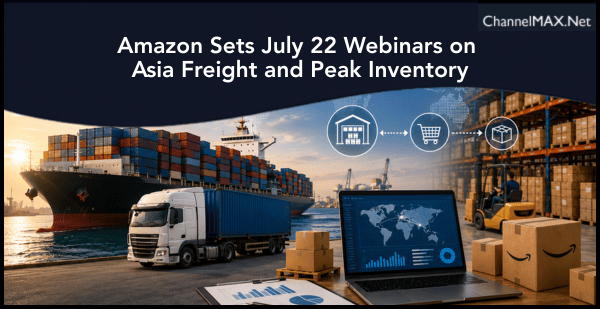
Free sessions will explain how sellers can use Amazon Global Logistics and Amazon Warehousing and Distribution to move inventory from Asia, manage bulk storage and reduce peak-season stockout risks
By ChannelMAX Staff Writer
July-2026#15
Keeping sufficient inventory available during peak shopping periods can be difficult for sellers importing products from Asia. Port congestion, long transit times, customs requirements and unexpected sales increases can all disrupt replenishment plans.
Two upcoming Amazon webinars will help sellers understand how to move products from Southeast Asia and Taiwan into the US fulfillment network. The sessions will also explain how Amazon Warehousing and Distribution can store bulk inventory and replenish FBA stock when demand increases.
The announcement was published on Amazon US Seller Central under the title “Webinars: Ship from Asia with AGL and stay stocked with AWD.” Both live sessions are scheduled for July 22, 2026, and will include opportunities for participants to ask questions.
Webinar to Cover AGL Ocean Freight From Asia
The first webinar, “Ship from Southeast Asia to US with AGL Ocean Freight,” will explain Amazon Global Logistics services for sellers sourcing products from Southeast Asia and Taiwan. The session is scheduled for July 22 at 9 a.m. Pacific Time. This corresponds to noon Eastern Time and 9:30 p.m. India Standard Time. It is open to sellers at all experience levels.
The webinar will focus on an AGL ocean freight route that connects participating Asian supply chains with Amazon’s US fulfillment network through Hong Kong. According to the Seller Central update, the route supports shipments originating from Taiwan, Vietnam, Thailand, Malaysia, Indonesia and Cambodia. Sellers will receive information about available origin ports, service routes and estimated transit times. Amazon will also demonstrate how to book shipments through Shipper Central.
Also Read: Amazon Reveals Key Q4 2026 Deadlines, Peak Fees And Deal Discounts For Sellers
End-to-End Cargo Movement Through Hong Kong
Amazon says the service is designed to maintain cargo security throughout transit. Shipments using the covered route do not require unstuffing, container switching or resealing while moving through Hong Kong.
Reducing cargo handling can help limit the risk of damage, delays or discrepancies during transit. However, sellers should still confirm cargo insurance, packaging standards, shipment documentation and liability provisions before booking.
The session will also cover built-in Country of Origin support. Accurate origin information is particularly important when customs authorities calculate duties or determine whether additional tariffs apply.
Amazon says this support can help sellers mitigate tariff risks. It does not, however, remove the seller’s customs responsibilities or guarantee a particular tariff treatment. Importers should verify product classifications, declared values, labeling requirements and Country of Origin documentation. Sellers dealing with regulated or high-value products may also benefit from consulting a qualified customs professional.
How Amazon Global Logistics Works
Amazon Global Logistics provides international freight services that connect manufacturing locations and origin ports with Amazon fulfillment centers and AWD facilities. Depending on the available route, shipment type and destination, sellers may be able to use full container load or less than container load ocean freight. Amazon also offers standard ocean, fast ocean and air freight options on eligible routes.
The service can include cargo pickup, labeling, palletization, customs clearance and delivery into the Amazon network. Available services and charges can vary by origin, destination and shipment. Sellers can use AGL to move eligible inventory directly to FBA or send bulk shipments to an AWD facility. Amazon says shipments sent to AWD can later be replenished into FBA based on inventory demand.
Webinar to Explain How Ship to AWD Supports Peak Planning
The second webinar, “Keep FBA listings stocked through peak with Ship to AWD,” will be held on July 22 at 2 a.m. Pacific Time. The session corresponds to 5 a.m. Eastern Time and 2:30 p.m. India Standard Time. It is also open to sellers at all experience levels. This webinar will explain how Amazon Warehousing and Distribution and Amazon Global Logistics can be used together.
The session will cover the Ship to AWD process, bulk inventory storage, automatic FBA replenishment and inventory allocation during peak periods. Amazon will also demonstrate the booking workflow and answer questions from participants.
AWD Stores Inventory Before FBA Needs It
Amazon Warehousing and Distribution is designed primarily for bulk storage. It holds products upstream until inventory is required in the FBA fulfillment network. FBA facilities are intended to store customer-ready inventory and fulfill orders. AWD facilities, by comparison, store larger quantities before those units are needed for customer orders.
When auto-replenishment is enabled, Amazon monitors inventory levels in its fulfillment network. It then transfers units from AWD to FBA based on demand signals. Amazon says inventory received by AWD can be considered available and buyable when auto-replenishment is enabled. This can help sellers maintain Prime-eligible offers while Amazon manages transfers into the FBA network.
Inventory automatically replenished from AWD is also not subject to FBA capacity limits, according to Amazon’s peak-readiness guidance. This could be valuable for sellers expecting higher sales during major shopping events or the holiday season. Sellers should remember that AWD eligibility varies by product. Amazon checks eligibility when a shipment is created. Inventory already stored in FBA cannot simply be transferred backward into AWD because the two facilities serve different purposes.
Potential Benefits During Peak Season
Using AGL with AWD could help sellers build an integrated supply chain from an Asian supplier to bulk storage in the United States. Instead of sending all imported units directly into FBA, a seller can place a larger shipment in AWD. Amazon can then move smaller quantities into FBA as demand changes.
This approach may help sellers reduce the risk of sending excessive stock to fulfillment centers too early. It can also provide a reserve inventory pool during sales events.
Amazon says AWD uses pay-as-you-go pricing and does not apply additional storage charges specifically for the holiday season. FBA inbound placement is included when inventory is replenished from AWD, subject to applicable program conditions.
Actual savings will depend on product size, storage duration, transportation method, sales velocity and the seller’s existing logistics costs.
Sellers Should Prepare Before Attending
Participants can make the webinars more useful by reviewing their current inventory and freight requirements beforehand. Sellers importing from the listed Asian markets should identify their origin port, shipment volume, product dimensions and expected production date. They should also estimate how much inventory will be available for shipping and when it will be needed in the US.
For the AWD webinar, sellers should review their FBA sales history, current stock levels, lead times and peak-season forecasts. This can help them ask specific questions about replenishment timing and inventory allocation.
Useful questions may include whether a product is eligible for AWD, how long receiving normally takes, how replenishment decisions are made and which charges are included in an AGL or Ship to AWD quote.
Sellers should also compare the complete landed cost rather than looking only at the quoted ocean freight rate. The calculation should include origin handling, customs duties, insurance, storage, labeling, destination charges and delivery into the Amazon network.
Recordings and Presentation Materials to Be Shared
Amazon said a recording and presentation deck for the AGL ocean freight session will be shared after the webinar. Sellers who cannot attend the live event may therefore still be able to review the material. Attending live, however, provides the added benefit of asking route-specific or account-specific questions during the question-and-answer segment.
Registration is available through the webinar links included in the original Seller Central announcement. Sellers should confirm the displayed time zone while registering and check whether the selected AGL route and AWD services are available for their accounts and products.
The July 22 webinars offer sellers an opportunity to understand how Amazon is connecting international freight, bulk storage and FBA replenishment within a more integrated system.
The AGL session will be particularly relevant to businesses sourcing from Taiwan, Vietnam, Thailand, Malaysia, Indonesia or Cambodia. The AWD session can help sellers planning large inbound shipments or preparing inventory for peak demand.
Used together, AGL and AWD may simplify carrier coordination, provide additional bulk-storage capacity and reduce the risk of FBA stockouts. Sellers should still evaluate fees, customs obligations, transit times and product eligibility before changing their supply chain.
For businesses preparing for the 2026 peak season, the webinars can provide practical guidance for deciding how much inventory to order, when to ship it and where it should be stored before customer demand rises.
Also Read: Holiday 2026 Planning Begins as Amazon Sets Earlier Deadlines for Peak Season Sellers
Disclaimer:
Amazon is the registered trademark of the company.
About ChannelMAX.NET:
ChannelMAX offers Amazon Repricer that runs on the latest AI Repricing algorithm to do Amazon Pricing Management or Amazon Repricing. Based on Amazon SP API, the repricing engine or repricer runs 24/7 and efficiently manages Amazon prices to maximize your BuyBox with profit optimization. Established in 2005, ChannelMAX has been integrated with Amazon technology since 2007, helping thousands of third-party sellers on various eCommerce platforms. Some of the eCommerce platforms, aka marketplaces, supported by ChannelMAX.NET, are Amazon, Walmart, eBay, and Shopify. Some of ChannelMAX key offerings include ChannelMAX Amazon Repricer, 2ndly, ChannelMAX Amazon FBA Audits and FBA Refunds management, an offering for managing Amazon FBA Refunds Reimbursement management for lost or damaged or misplaced inventory for which Amazon is responsible and for which sellers deserve appropriate credit reimbursement from Amazon. ChannelMAX Services offer Remote (aka Virtual) Full-Time eCommerce Assistant to help 3P sellers run their daytoday business.
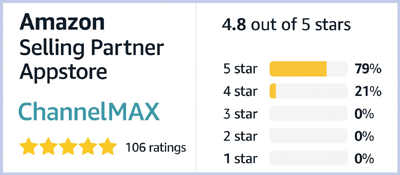
Check ChannelMAX at Amazon Selling Partner Appstore, an application with a 5 star rating.
By ChannelMAX Staff Writer
July-2026#15
Keeping sufficient inventory available during peak shopping periods can be difficult for sellers importing products from Asia. Port congestion, long transit times, customs requirements and unexpected sales increases can all disrupt replenishment plans.
Two upcoming Amazon webinars will help sellers understand how to move products from Southeast Asia and Taiwan into the US fulfillment network. The sessions will also explain how Amazon Warehousing and Distribution can store bulk inventory and replenish FBA stock when demand increases.
The announcement was published on Amazon US Seller Central under the title “Webinars: Ship from Asia with AGL and stay stocked with AWD.” Both live sessions are scheduled for July 22, 2026, and will include opportunities for participants to ask questions.
Webinar to Cover AGL Ocean Freight From Asia
The first webinar, “Ship from Southeast Asia to US with AGL Ocean Freight,” will explain Amazon Global Logistics services for sellers sourcing products from Southeast Asia and Taiwan. The session is scheduled for July 22 at 9 a.m. Pacific Time. This corresponds to noon Eastern Time and 9:30 p.m. India Standard Time. It is open to sellers at all experience levels.
The webinar will focus on an AGL ocean freight route that connects participating Asian supply chains with Amazon’s US fulfillment network through Hong Kong. According to the Seller Central update, the route supports shipments originating from Taiwan, Vietnam, Thailand, Malaysia, Indonesia and Cambodia. Sellers will receive information about available origin ports, service routes and estimated transit times. Amazon will also demonstrate how to book shipments through Shipper Central.
Also Read: Amazon Reveals Key Q4 2026 Deadlines, Peak Fees And Deal Discounts For Sellers
End-to-End Cargo Movement Through Hong Kong
Amazon says the service is designed to maintain cargo security throughout transit. Shipments using the covered route do not require unstuffing, container switching or resealing while moving through Hong Kong.
Reducing cargo handling can help limit the risk of damage, delays or discrepancies during transit. However, sellers should still confirm cargo insurance, packaging standards, shipment documentation and liability provisions before booking.
The session will also cover built-in Country of Origin support. Accurate origin information is particularly important when customs authorities calculate duties or determine whether additional tariffs apply.
Amazon says this support can help sellers mitigate tariff risks. It does not, however, remove the seller’s customs responsibilities or guarantee a particular tariff treatment. Importers should verify product classifications, declared values, labeling requirements and Country of Origin documentation. Sellers dealing with regulated or high-value products may also benefit from consulting a qualified customs professional.
How Amazon Global Logistics Works
Amazon Global Logistics provides international freight services that connect manufacturing locations and origin ports with Amazon fulfillment centers and AWD facilities. Depending on the available route, shipment type and destination, sellers may be able to use full container load or less than container load ocean freight. Amazon also offers standard ocean, fast ocean and air freight options on eligible routes.
The service can include cargo pickup, labeling, palletization, customs clearance and delivery into the Amazon network. Available services and charges can vary by origin, destination and shipment. Sellers can use AGL to move eligible inventory directly to FBA or send bulk shipments to an AWD facility. Amazon says shipments sent to AWD can later be replenished into FBA based on inventory demand.
Webinar to Explain How Ship to AWD Supports Peak Planning
The second webinar, “Keep FBA listings stocked through peak with Ship to AWD,” will be held on July 22 at 2 a.m. Pacific Time. The session corresponds to 5 a.m. Eastern Time and 2:30 p.m. India Standard Time. It is also open to sellers at all experience levels. This webinar will explain how Amazon Warehousing and Distribution and Amazon Global Logistics can be used together.
The session will cover the Ship to AWD process, bulk inventory storage, automatic FBA replenishment and inventory allocation during peak periods. Amazon will also demonstrate the booking workflow and answer questions from participants.
AWD Stores Inventory Before FBA Needs It
Amazon Warehousing and Distribution is designed primarily for bulk storage. It holds products upstream until inventory is required in the FBA fulfillment network. FBA facilities are intended to store customer-ready inventory and fulfill orders. AWD facilities, by comparison, store larger quantities before those units are needed for customer orders.
When auto-replenishment is enabled, Amazon monitors inventory levels in its fulfillment network. It then transfers units from AWD to FBA based on demand signals. Amazon says inventory received by AWD can be considered available and buyable when auto-replenishment is enabled. This can help sellers maintain Prime-eligible offers while Amazon manages transfers into the FBA network.
Inventory automatically replenished from AWD is also not subject to FBA capacity limits, according to Amazon’s peak-readiness guidance. This could be valuable for sellers expecting higher sales during major shopping events or the holiday season. Sellers should remember that AWD eligibility varies by product. Amazon checks eligibility when a shipment is created. Inventory already stored in FBA cannot simply be transferred backward into AWD because the two facilities serve different purposes.
Potential Benefits During Peak Season
Using AGL with AWD could help sellers build an integrated supply chain from an Asian supplier to bulk storage in the United States. Instead of sending all imported units directly into FBA, a seller can place a larger shipment in AWD. Amazon can then move smaller quantities into FBA as demand changes.
This approach may help sellers reduce the risk of sending excessive stock to fulfillment centers too early. It can also provide a reserve inventory pool during sales events.
Amazon says AWD uses pay-as-you-go pricing and does not apply additional storage charges specifically for the holiday season. FBA inbound placement is included when inventory is replenished from AWD, subject to applicable program conditions.
Actual savings will depend on product size, storage duration, transportation method, sales velocity and the seller’s existing logistics costs.
Sellers Should Prepare Before Attending
Participants can make the webinars more useful by reviewing their current inventory and freight requirements beforehand. Sellers importing from the listed Asian markets should identify their origin port, shipment volume, product dimensions and expected production date. They should also estimate how much inventory will be available for shipping and when it will be needed in the US.
For the AWD webinar, sellers should review their FBA sales history, current stock levels, lead times and peak-season forecasts. This can help them ask specific questions about replenishment timing and inventory allocation.
Useful questions may include whether a product is eligible for AWD, how long receiving normally takes, how replenishment decisions are made and which charges are included in an AGL or Ship to AWD quote.
Sellers should also compare the complete landed cost rather than looking only at the quoted ocean freight rate. The calculation should include origin handling, customs duties, insurance, storage, labeling, destination charges and delivery into the Amazon network.
Recordings and Presentation Materials to Be Shared
Amazon said a recording and presentation deck for the AGL ocean freight session will be shared after the webinar. Sellers who cannot attend the live event may therefore still be able to review the material. Attending live, however, provides the added benefit of asking route-specific or account-specific questions during the question-and-answer segment.
Registration is available through the webinar links included in the original Seller Central announcement. Sellers should confirm the displayed time zone while registering and check whether the selected AGL route and AWD services are available for their accounts and products.
The July 22 webinars offer sellers an opportunity to understand how Amazon is connecting international freight, bulk storage and FBA replenishment within a more integrated system.
The AGL session will be particularly relevant to businesses sourcing from Taiwan, Vietnam, Thailand, Malaysia, Indonesia or Cambodia. The AWD session can help sellers planning large inbound shipments or preparing inventory for peak demand.
Used together, AGL and AWD may simplify carrier coordination, provide additional bulk-storage capacity and reduce the risk of FBA stockouts. Sellers should still evaluate fees, customs obligations, transit times and product eligibility before changing their supply chain.
For businesses preparing for the 2026 peak season, the webinars can provide practical guidance for deciding how much inventory to order, when to ship it and where it should be stored before customer demand rises.
Also Read: Holiday 2026 Planning Begins as Amazon Sets Earlier Deadlines for Peak Season Sellers
Disclaimer:
Amazon is the registered trademark of the company.
About ChannelMAX.NET:
ChannelMAX offers Amazon Repricer that runs on the latest AI Repricing algorithm to do Amazon Pricing Management or Amazon Repricing. Based on Amazon SP API, the repricing engine or repricer runs 24/7 and efficiently manages Amazon prices to maximize your BuyBox with profit optimization. Established in 2005, ChannelMAX has been integrated with Amazon technology since 2007, helping thousands of third-party sellers on various eCommerce platforms. Some of the eCommerce platforms, aka marketplaces, supported by ChannelMAX.NET, are Amazon, Walmart, eBay, and Shopify. Some of ChannelMAX key offerings include ChannelMAX Amazon Repricer, 2ndly, ChannelMAX Amazon FBA Audits and FBA Refunds management, an offering for managing Amazon FBA Refunds Reimbursement management for lost or damaged or misplaced inventory for which Amazon is responsible and for which sellers deserve appropriate credit reimbursement from Amazon. ChannelMAX Services offer Remote (aka Virtual) Full-Time eCommerce Assistant to help 3P sellers run their daytoday business.
Check ChannelMAX at Amazon Selling Partner Appstore, an application with a 5 star rating.