Amazon Tightens Product Compliance With Direct Third-Party Testing
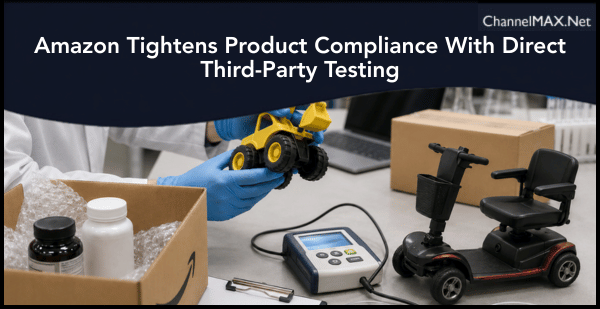
Sellers can no longer upload test documents themselves for affected products and must request verification through an Amazon-approved provider
By ChannelMAX Staff Writer
July-2026#22
Product compliance is becoming a more direct and controlled process for sellers in several regulated categories on Amazon US. Affected products must be verified by an approved testing, inspection and certification provider to remain available for purchase. The update was published on Seller Central under the title “Understand testing, inspection, and certification requirements.” It applies to selected product categories, including dietary supplements, children’s toys and electronic mobility products.
A major requirement is that compliance results must be sent to Amazon directly by an approved third-party provider. Sellers can no longer upload these test reports or certificates themselves for products included in the direct product-validation process.
Also Read: Amazon Highlights Three Shopping Trends Sellers Can Use to Compete in 2026
What the new guidance means for sellers
Amazon uses testing, inspection and certification services to confirm that regulated products meet applicable safety standards and its marketplace policies. The process is often referred to as TIC verification. It may involve laboratory testing, document inspection, product certification or a combination of these measures, depending on the product category and compliance request.
When an ASIN is selected for verification, the seller receives a compliance notification. The seller must then choose an approved provider through Seller Central and request laboratory service. Amazon says testing normally takes about 30 days after the provider receives the required product samples. Sellers are therefore advised to begin the process quickly instead of waiting until the deadline approaches.
Self-uploaded documents no longer accepted
The most important point for sellers is that test results must come directly from an Amazon-approved TIC provider. Even if a seller already possesses a laboratory report or safety certificate, uploading it independently may not satisfy the request. The selected provider must verify the product and submit the compliance results to Amazon.
Sellers with existing reports should give them to the approved provider for evaluation. The provider can determine whether the previous testing meets the current requirements or whether new or additional tests are necessary. Sellers should not send samples to an unlisted laboratory before checking the options displayed in Seller Central. The providers approved for one category may differ from those available for another product.
How to request testing
After receiving a compliance notification, sellers can start the process through Account Health.
The steps provided by Amazon are:
1. Open Account Health in Seller Central.
2. Select Policy Compliance.
3. Choose Food and Product Safety Issues.
4. Click Submit beside the affected product.
5. Select Verify Your Product.
6. Choose an approved testing, inspection and certification provider.
7. Select Request Lab Service.
8. Complete and submit the request by the deadline shown in Amazon’s notification or request email.
The selected provider is expected to contact the seller within two business days with information about samples, documents, testing fees and the next steps.
Amazon’s official guidance is available on its third-party testing, inspection and certification services page.
Why sellers should act early
The testing period typically begins only after the provider receives the samples and necessary information. Time may also be required to prepare samples, arrange delivery, answer questions or conduct additional testing. A seller who starts close to the deadline could face difficulties if the shipment is delayed, the sample is unsuitable or the product fails an initial test.
Failure to submit the lab-service request by the specified date could affect the listing. The product may become unavailable for purchase until Amazon receives and accepts the required verification.
Sellers should record the following information as soon as a notification arrives:
1. The affected ASIN and SKU.
2. The compliance issue and product category.
3. The deadline shown in Seller Central.
4. The selected TIC provider.
5. The lab-service request number.
6. The date samples were dispatched.
7. Shipment tracking information.
8. Communications received from the provider.
9. Testing fees and payment details.
10. The final result and Amazon’s compliance status.
Which products may require verification
The Seller Central update specifically mentions dietary supplements, children’s toys and electronic mobility products. However, direct product validation can apply to other regulated categories as well. The exact requirements depend on the product, its intended use and the applicable safety rules. Sellers should rely on the compliance request displayed for the affected ASIN rather than assuming that one report covers every product in a catalog.
Products that appear similar may require separate verification when they have different materials, ingredients, electrical components, designs, manufacturers or production locations. A certificate issued for one model or formulation should not automatically be used for another product unless the approved provider confirms that it is covered.
Testing costs and product samples
The announcement does not provide a universal testing price. Fees can vary depending on the product category, number of tests, sample quantity and provider. Before proceeding, sellers should ask the selected provider for a written quotation and a list of required samples and documents. They should also confirm whether the samples will be returned, retained or destroyed after testing.
Commonly requested information may include product labels, packaging images, ingredient lists, technical specifications, manufacturing details and previous laboratory reports. The provider will determine what is needed for the specific request. Sellers should make sure the sample matches the product offered on Amazon. Differences in branding, formulation, packaging, model numbers or safety markings may delay verification.
How to appeal an incorrect compliance request
A seller may appeal if the product has been incorrectly classified or if the requirement does not apply to the ASIN.
Amazon provided the following appeal route:
1. Open Account Health.
2. Select Manage Your Compliance.
3. Choose Add or Appeal Compliance for the affected product.
4. Select Appeal Request.
5. Provide the reason for the appeal and supporting information.
The appeal should be specific and evidence-based. Sellers can include product photographs, packaging details, technical information or an explanation of why the ASIN falls outside the regulated category. Submitting an appeal does not guarantee approval. Sellers should continue monitoring the compliance deadline unless Amazon confirms that the requirement has been removed.
Practical steps to reduce compliance risk
Sellers in regulated categories should review Account Health and Manage Your Compliance regularly. Compliance notifications should be treated as time-sensitive operational tasks. Businesses should also ensure that the email address connected to Seller Central is monitored. The approved provider is expected to make contact within two business days, and delays in responding may extend the testing timeline.
Manufacturers and suppliers should be informed about Amazon’s direct-verification process. Sellers may need their assistance to obtain samples, manufacturing records, formulation details or technical documents. It is also advisable to include testing expenses and lead times in product-launch planning. Waiting for a listing restriction before arranging verification could lead to lost sales and stranded inventory.
A more controlled compliance process
Amazon’s direct TIC model is intended to improve the reliability of product-safety verification by ensuring that results come from approved independent providers. For sellers, however, it removes the option of simply uploading their own compliance documents.
The most effective response is to act immediately after receiving a notification, request service through Seller Central and maintain close communication with the selected provider.
Sellers who understand the process can reduce the risk of listing interruptions, plan testing costs more accurately and address compliance problems before they affect sales. Early preparation is especially important because testing may take around 30 days after samples reach the provider.
Also Read: Amazon AWD Expands to Five European Markets With Long-Term Bulk Storage
Disclaimer:
Amazon is the registered trademark of the company.
About ChannelMAX.NET:
ChannelMAX offers Amazon Repricer that runs on the latest AI Repricing algorithm to do Amazon Pricing Management or Amazon Repricing. Based on Amazon SP API, the repricing engine or repricer runs 24/7 and efficiently manages Amazon prices to maximize your BuyBox with profit optimization. Established in 2005, ChannelMAX has been integrated with Amazon technology since 2007, helping thousands of third-party sellers on various eCommerce platforms. Some of the eCommerce platforms, aka marketplaces, supported by ChannelMAX.NET, are Amazon, Walmart, eBay, and Shopify. Some of ChannelMAX key offerings include ChannelMAX Amazon Repricer, 2ndly, ChannelMAX Amazon FBA Audits and FBA Refunds management, an offering for managing Amazon FBA Refunds Reimbursement management for lost or damaged or misplaced inventory for which Amazon is responsible and for which sellers deserve appropriate credit reimbursement from Amazon. ChannelMAX Services offer Remote (aka Virtual) Full-Time eCommerce Assistant to help 3P sellers run their daytoday business.
Check ChannelMAX at Amazon Selling Partner Appstore, an application with a 5 star rating.
By ChannelMAX Staff Writer
July-2026#22
Product compliance is becoming a more direct and controlled process for sellers in several regulated categories on Amazon US. Affected products must be verified by an approved testing, inspection and certification provider to remain available for purchase. The update was published on Seller Central under the title “Understand testing, inspection, and certification requirements.” It applies to selected product categories, including dietary supplements, children’s toys and electronic mobility products.
A major requirement is that compliance results must be sent to Amazon directly by an approved third-party provider. Sellers can no longer upload these test reports or certificates themselves for products included in the direct product-validation process.
Also Read: Amazon Highlights Three Shopping Trends Sellers Can Use to Compete in 2026
What the new guidance means for sellers
Amazon uses testing, inspection and certification services to confirm that regulated products meet applicable safety standards and its marketplace policies. The process is often referred to as TIC verification. It may involve laboratory testing, document inspection, product certification or a combination of these measures, depending on the product category and compliance request.
When an ASIN is selected for verification, the seller receives a compliance notification. The seller must then choose an approved provider through Seller Central and request laboratory service. Amazon says testing normally takes about 30 days after the provider receives the required product samples. Sellers are therefore advised to begin the process quickly instead of waiting until the deadline approaches.
Self-uploaded documents no longer accepted
The most important point for sellers is that test results must come directly from an Amazon-approved TIC provider. Even if a seller already possesses a laboratory report or safety certificate, uploading it independently may not satisfy the request. The selected provider must verify the product and submit the compliance results to Amazon.
Sellers with existing reports should give them to the approved provider for evaluation. The provider can determine whether the previous testing meets the current requirements or whether new or additional tests are necessary. Sellers should not send samples to an unlisted laboratory before checking the options displayed in Seller Central. The providers approved for one category may differ from those available for another product.
How to request testing
After receiving a compliance notification, sellers can start the process through Account Health.
The steps provided by Amazon are:
1. Open Account Health in Seller Central.
2. Select Policy Compliance.
3. Choose Food and Product Safety Issues.
4. Click Submit beside the affected product.
5. Select Verify Your Product.
6. Choose an approved testing, inspection and certification provider.
7. Select Request Lab Service.
8. Complete and submit the request by the deadline shown in Amazon’s notification or request email.
The selected provider is expected to contact the seller within two business days with information about samples, documents, testing fees and the next steps.
Amazon’s official guidance is available on its third-party testing, inspection and certification services page.
Why sellers should act early
The testing period typically begins only after the provider receives the samples and necessary information. Time may also be required to prepare samples, arrange delivery, answer questions or conduct additional testing. A seller who starts close to the deadline could face difficulties if the shipment is delayed, the sample is unsuitable or the product fails an initial test.
Failure to submit the lab-service request by the specified date could affect the listing. The product may become unavailable for purchase until Amazon receives and accepts the required verification.
Sellers should record the following information as soon as a notification arrives:
1. The affected ASIN and SKU.
2. The compliance issue and product category.
3. The deadline shown in Seller Central.
4. The selected TIC provider.
5. The lab-service request number.
6. The date samples were dispatched.
7. Shipment tracking information.
8. Communications received from the provider.
9. Testing fees and payment details.
10. The final result and Amazon’s compliance status.
Which products may require verification
The Seller Central update specifically mentions dietary supplements, children’s toys and electronic mobility products. However, direct product validation can apply to other regulated categories as well. The exact requirements depend on the product, its intended use and the applicable safety rules. Sellers should rely on the compliance request displayed for the affected ASIN rather than assuming that one report covers every product in a catalog.
Products that appear similar may require separate verification when they have different materials, ingredients, electrical components, designs, manufacturers or production locations. A certificate issued for one model or formulation should not automatically be used for another product unless the approved provider confirms that it is covered.
Testing costs and product samples
The announcement does not provide a universal testing price. Fees can vary depending on the product category, number of tests, sample quantity and provider. Before proceeding, sellers should ask the selected provider for a written quotation and a list of required samples and documents. They should also confirm whether the samples will be returned, retained or destroyed after testing.
Commonly requested information may include product labels, packaging images, ingredient lists, technical specifications, manufacturing details and previous laboratory reports. The provider will determine what is needed for the specific request. Sellers should make sure the sample matches the product offered on Amazon. Differences in branding, formulation, packaging, model numbers or safety markings may delay verification.
How to appeal an incorrect compliance request
A seller may appeal if the product has been incorrectly classified or if the requirement does not apply to the ASIN.
Amazon provided the following appeal route:
1. Open Account Health.
2. Select Manage Your Compliance.
3. Choose Add or Appeal Compliance for the affected product.
4. Select Appeal Request.
5. Provide the reason for the appeal and supporting information.
The appeal should be specific and evidence-based. Sellers can include product photographs, packaging details, technical information or an explanation of why the ASIN falls outside the regulated category. Submitting an appeal does not guarantee approval. Sellers should continue monitoring the compliance deadline unless Amazon confirms that the requirement has been removed.
Practical steps to reduce compliance risk
Sellers in regulated categories should review Account Health and Manage Your Compliance regularly. Compliance notifications should be treated as time-sensitive operational tasks. Businesses should also ensure that the email address connected to Seller Central is monitored. The approved provider is expected to make contact within two business days, and delays in responding may extend the testing timeline.
Manufacturers and suppliers should be informed about Amazon’s direct-verification process. Sellers may need their assistance to obtain samples, manufacturing records, formulation details or technical documents. It is also advisable to include testing expenses and lead times in product-launch planning. Waiting for a listing restriction before arranging verification could lead to lost sales and stranded inventory.
A more controlled compliance process
Amazon’s direct TIC model is intended to improve the reliability of product-safety verification by ensuring that results come from approved independent providers. For sellers, however, it removes the option of simply uploading their own compliance documents.
The most effective response is to act immediately after receiving a notification, request service through Seller Central and maintain close communication with the selected provider.
Sellers who understand the process can reduce the risk of listing interruptions, plan testing costs more accurately and address compliance problems before they affect sales. Early preparation is especially important because testing may take around 30 days after samples reach the provider.
Also Read: Amazon AWD Expands to Five European Markets With Long-Term Bulk Storage
Disclaimer:
Amazon is the registered trademark of the company.
About ChannelMAX.NET:
ChannelMAX offers Amazon Repricer that runs on the latest AI Repricing algorithm to do Amazon Pricing Management or Amazon Repricing. Based on Amazon SP API, the repricing engine or repricer runs 24/7 and efficiently manages Amazon prices to maximize your BuyBox with profit optimization. Established in 2005, ChannelMAX has been integrated with Amazon technology since 2007, helping thousands of third-party sellers on various eCommerce platforms. Some of the eCommerce platforms, aka marketplaces, supported by ChannelMAX.NET, are Amazon, Walmart, eBay, and Shopify. Some of ChannelMAX key offerings include ChannelMAX Amazon Repricer, 2ndly, ChannelMAX Amazon FBA Audits and FBA Refunds management, an offering for managing Amazon FBA Refunds Reimbursement management for lost or damaged or misplaced inventory for which Amazon is responsible and for which sellers deserve appropriate credit reimbursement from Amazon. ChannelMAX Services offer Remote (aka Virtual) Full-Time eCommerce Assistant to help 3P sellers run their daytoday business.
Check ChannelMAX at Amazon Selling Partner Appstore, an application with a 5 star rating.