Amazon UK adds multiple Buy Delivery labels for multi-box orders
By ChannelMAX Staff Writer
July-2026#19
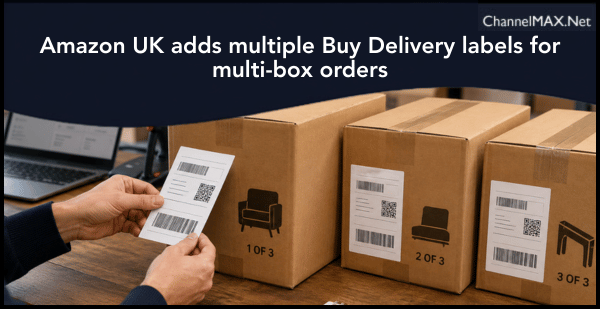
Amazon UK has introduced a simpler way for merchant-fulfilled sellers to dispatch products that require more than one box. From July 14, 2026, sellers can purchase multiple delivery labels for a single-quantity item through Buy Delivery. The update was announced on Amazon Seller Central under the title “Purchase multiple labels in Buy Delivery for multiple box orders.”
The feature is particularly useful for furniture, fitness equipment, appliances, modular products and other listings whose parts must be packed separately. Sellers can now manage these packages within the same order instead of using a less coordinated process for additional boxes.
Also Read: Amazon Outlet Offers Sellers a Back-to-School Inventory Clearance Opportunity
How the new multi-box option works
When buying delivery through Seller Central, a seller can select the number of packages required for the item. Buy Delivery will then display consolidated delivery rates for the complete multi-box shipment.
Each box receives:
1. Its own delivery label
2. A unique shipment ID
3. A separate tracking number
This means every package can be tracked individually from dispatch to delivery. For example, if a customer orders one piece of furniture that is packed in three boxes, the seller can select three packages. Amazon will create three labels and three shipment IDs, while keeping the packages connected to the customer’s order.
Clearer tracking for customers
Customers will be able to see the tracking status and expected delivery date for each package in their order. This is important because different boxes from the same order may move through the carrier’s network at different speeds. One package may arrive earlier than the others. Separate tracking can help customers understand that the remaining parts are still in transit rather than assuming the order is incomplete or lost. Better visibility may also reduce “Where is my order?” messages and premature refund requests.
Package-level delivery metrics
Amazon said each package will be considered separately when calculating the seller’s Valid Tracking Rate and on-time delivery rate. This makes accurate label use especially important. Sellers should attach the correct label to its assigned package and ensure that every tracking number receives a valid carrier scan. If a three-box order has only two correctly scanned tracking numbers, the untracked package could affect delivery-performance measurement even if the other two arrive on time.
Support for claims and delivery disputes
Package-level tracking will also help Amazon process A-to-z Guarantee and SAFE-T claims more accurately. When a customer reports that only part of an order arrived, Amazon and the seller will have tracking information for each package. This should make it easier to determine which boxes were delivered, delayed, damaged or lost.
Amazon’s public guidance says Buy Shipping, known as Buy Delivery in some Seller Central workflows, allows sellers to purchase and print labels from supported carriers in one place. Eligible sellers who purchase labels through the service and dispatch orders on time may also receive protection in certain delivery-related A-to-z Guarantee claims. Any protection remains subject to Amazon’s applicable terms and the facts of the claim.
What sellers should do before buying labels
Sellers using the new option should prepare accurate information for every box, including its weight and dimensions. Incorrect package data could result in an unsuitable delivery service, carrier adjustments or additional charges.
Before confirming the label purchase, sellers should:
1. Count the exact number of boxes required.
2. Enter accurate dimensions and weight for each package.
3. Check the consolidated delivery rate and selected carrier service.
4. Match every printed label with the correct box.
5. Avoid placing the same tracking label on multiple packages.
6. Obtain and retain carrier acceptance scans or collection records.
7. Monitor all tracking numbers until every part has been delivered.
The boxes should also be clearly marked where appropriate, such as “Box 1 of 3,” “Box 2 of 3” and “Box 3 of 3.” These markings do not replace Amazon or carrier labels, but they can help the seller, carrier and customer identify the complete set.
Sellers should review their packaging process
Businesses selling multi-part products should update their standard operating procedures to reflect the new workflow. Warehouse staff and third-party logistics providers need to understand that every package requires its assigned label. Sellers should also review listings for products regularly shipped in multiple boxes. Product pages and packaging should make it clear when an item arrives in separate parts. This can prevent customers from mistaking the first delivery for an incomplete order. Amazon directs sellers to the Seller Central help page titled “Dispatching products with multiple parts” for step-by-step instructions.
A useful improvement for multi-box fulfilment
The update gives Amazon UK sellers a more structured way to manage products that cannot be dispatched in a single carton. Separate labels and package-level tracking can improve delivery visibility, simplify the handling of partial-delivery disputes and provide clearer evidence for eligible claims.
The main benefit will depend on careful execution. Sellers must enter accurate package details, apply the correct labels and ensure that every box receives a carrier scan. When used correctly, the feature can make multi-box fulfilment easier for sellers and more transparent for customers.
Also Read: Amazon Highlights Three Shopping Trends Sellers Can Use to Compete in 2026
Disclaimer:
Amazon is the registered trademark of the company.
About ChannelMAX.NET
ChannelMAX offers an Amazon Repricer powered by the latest AI repricing algorithm for Amazon pricing management. Built on the Amazon SP-API, the repricing engine operates 24/7 to manage prices efficiently, increase Buy Box opportunities, and optimize profitability.
Established in 2005 and integrated with Amazon technology since 2007, ChannelMAX has helped thousands of third-party sellers across marketplaces and eCommerce platforms, including Amazon, Walmart, eBay, and Shopify.
Key offerings include the ChannelMAX Amazon Repricer , Amazon FBA audits, and FBA Refunds management . The FBA reimbursement service helps sellers identify and recover eligible credits for inventory lost, damaged, or misplaced while under Amazon’s responsibility.
ChannelMAX Services also provides remote, full-time eCommerce assistants who help third-party sellers manage their day-to-day business operations.
Find ChannelMAX in the Amazon Selling Partner Appstore — a five-star-rated application.