Amazon Reopens FBA for Meltable Inventory With Staggered Dates Starting August 31
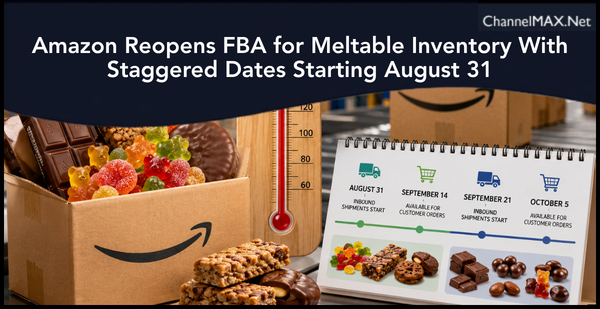
Sellers of gummies, protein bars, chocolate and other heat-sensitive products should check category-specific inbound and customer-order dates before sending inventory
By ChannelMAX Staff Writer
Aug-2026#13
Amazon FBA sellers dealing in heat-sensitive products can soon begin restocking fulfillment centers after the seasonal restrictions on meltable inventory. The reopening starts August 31, 2026, but Amazon is using different schedules depending on the type of product.
The new schedule is especially important for sellers of gummies, chocolate, protein bars, coated candy and other products that can be affected by high temperatures. Planning shipments around the correct dates can help sellers get inventory positioned before their products become available for customer orders.
The update was posted on Amazon's US Seller Central platform. Amazon said the reopening has been scheduled by product type so inventory can be prepared for customer orders at the appropriate time.
First group can be sent to FBA from August 31
The earliest reopening applies to several types of heat-sensitive products. Starting August 31, 2026, sellers can send the following inventory to FBA:
i) Coated gummies
ii) Pectin gummies
iii) Protein bars
iv) Cookies
v) Coated candy
Amazon says products in this group will become available for customer orders beginning September 14, 2026. This creates a two-week period between the start of inbound shipments and the date Amazon plans to make these products available for customer orders.
Sellers can use this window to position inventory at Amazon fulfillment centers ahead of the reopening for sales.
Also Read: Labor Day Sale 2026: Amazon urges US sellers to clear excess inventory and launch deals before Q4
Chocolate and other products follow on September 21
A second group of meltable products has a later schedule. Starting September 21, 2026, sellers can send:
i) All chocolate
ii) Chocolate-coated nuts
iii) Chocolate-coated fruitm
iv) Chocolate-coated caramel
v) Gelatin gummies
These products are scheduled to become available for customer orders beginning October 5, 2026.
Sellers should pay particular attention to the distinction between different types of gummies. Coated and pectin gummies fall under the August 31 inbound date, while gelatin gummies are included in the later September 21 schedule.
What Amazon considers meltable inventory
Amazon defines meltable inventory as heat-sensitive products that can melt when exposed to temperatures of 155 degrees Fahrenheit for extended periods. This includes chocolate, gummies and certain jelly- and wax-based products, among other heat-sensitive items.
The policy exists because products stored and transported through the FBA network can encounter high temperatures during warmer months. Heat exposure can affect product quality, packaging and the condition in which an item reaches the customer.
Why Amazon restricts meltable products seasonally
Amazon places seasonal restrictions on meltable inventory to protect product quality within its fulfillment network. Earlier in 2026, Amazon told sellers that it would not accept meltable inventory at its fulfillment centers between April 20 and September 28 under its seasonal policy.
The latest Seller Central update introduces a staggered reopening that allows certain product types to enter the FBA network earlier than others. This makes it important for sellers to follow the latest product-specific schedule rather than relying only on the broader seasonal dates previously communicated.
Send to Amazon opens for eligible products August 31
Sellers can begin creating shipments containing eligible meltable inventory through the Send to Amazon workflow starting August 31, 2026. However, the ability to send inventory does not mean every meltable product becomes eligible on that date.
Sellers should first identify which reopening group applies to their ASIN. For example, a seller shipping pectin gummies may begin sending eligible inventory on August 31. A seller with chocolate products should wait until the September 21 inbound date.
Checking this distinction before creating shipments can help sellers avoid sending inventory too early.
Review Amazon's meltable ASIN list
Amazon directs sellers to its Meltable FBA Inventory guidance, where they can also download a list of meltable ASINs. This should be an important step for sellers whose products may fall into a borderline category.
A product does not necessarily have to be a conventional chocolate bar to be affected by the policy. Amazon's definition can cover other heat-sensitive products, including selected jelly- and wax-based items. Sellers should therefore check their ASINs rather than deciding eligibility solely from the product category or product title.
What if a product is incorrectly classified as meltable?
Some sellers may believe that an ASIN classified as meltable can safely withstand Amazon's required temperatures. Amazon has previously provided a process for sellers seeking an exemption from the meltable classification.
According to Amazon guidance, sellers can contact Selling Partner Support with documentation from the manufacturer. The documentation should be on the manufacturer's letterhead and identify the affected products or ASINs.
It should also explicitly confirm that the products can be stored at a maximum temperature of 155 degrees Fahrenheit for extended periods and provide a contact for verification.
Sellers considering this route should check the current Meltable FBA Inventory policy in Seller Central for the latest requirements before submitting documentation.
Why sellers should start inventory planning now
The reopening dates arrive ahead of the important fourth-quarter selling period in the US. For sellers of chocolate, candy, gummies, snacks and similar products, inventory planning can therefore begin before the products actually become available for customer orders.
Sellers should estimate how much inventory they need based on sales history, expected demand, current stock and inbound transportation times.
Sending too little inventory could increase the risk of running out of stock after sales resume. Sending excessive quantities can create a different problem by increasing inventory-related costs if demand does not meet expectations.
Sellers should therefore use the reopening as a replenishment planning opportunity rather than simply sending the maximum quantity possible.
Plan around inbound dates, not only sales dates
One of the most useful parts of Amazon's announcement is the separation between the date sellers can send products and the date those products become available for customer orders.
For the first group, the key dates are:
August 31, 2026: Eligible inbound shipments can begin.
September 14, 2026: Products become available for customer orders.
For the second group:
September 21, 2026: Eligible inbound shipments can begin.
October 5, 2026: Products become available for customer orders.
Sellers should plan backward from these dates while considering transportation time, carrier delays and Amazon's receiving and processing time.
The goal should be to have enough inventory received and ready when customer ordering resumes without creating unnecessary overstock.
What FBA sellers should do now
Sellers with meltable products should review their catalogs and identify every ASIN affected by Amazon's policy. They should separate inventory according to the August 31 and September 21 inbound groups.
Next, sellers can estimate replenishment quantities using recent sales data and expected seasonal demand. Products with strong holiday or fourth-quarter demand may require particularly careful planning.
Sellers should also check shipment eligibility in Seller Central before dispatching inventory and monitor inbound shipments until units are received and available. If there is uncertainty about whether an ASIN is classified as meltable, sellers should review Amazon's downloadable meltable ASIN list and current policy before shipping.
The reopening of Amazon FBA for meltable inventory gives sellers an opportunity to rebuild stock ahead of the fall and fourth-quarter selling periods, but the 2026 schedule requires more attention than a single reopening date.
Eligible coated and pectin gummies, protein bars, cookies and coated candy can begin moving into FBA on August 31 and are scheduled to become available for customer orders September 14. Chocolate and several other heat-sensitive products, including gelatin gummies, follow with a September 21 inbound date and October 5 customer-order date.
For sellers, the main benefit is the ability to position inventory before sales resume. Those who review affected ASINs, forecast demand and create shipments at the correct time can be better prepared when their meltable products return to FBA availability.
The safest approach is to check each affected ASIN against Amazon's current Meltable FBA Inventory guidance before shipping. This can help sellers avoid sending restricted products too early while giving eligible inventory enough time to reach Amazon's fulfillment network before customer ordering resumes.
Also Read: Amazon Launches Prime Air Drone Delivery in UK, Offering Deliveries Within 60 Minutes
Disclaimer:
Amazon is the registered trademark of the company.
About ChannelMAX.NET:
ChannelMAX offers Amazon Repricer that runs on the latest AI Repricing algorithm to do Amazon Pricing Management or Amazon Repricing. Based on Amazon SP API, the repricing engine or repricer runs 24/7 and efficiently manages Amazon prices to maximize your BuyBox with profit optimization. Established in 2005, ChannelMAX has been integrated with Amazon technology since 2007, helping thousands of third-party sellers on various eCommerce platforms. Some of the eCommerce platforms, aka marketplaces, supported by ChannelMAX.NET, are Amazon, Walmart, eBay, and Shopify. Some of ChannelMAX key offerings include ChannelMAX Amazon Repricer, 2ndly, ChannelMAX Amazon FBA Audits and FBA Refunds management, an offering for managing Amazon FBA Refunds Reimbursement management for lost or damaged or misplaced inventory for which Amazon is responsible and for which sellers deserve appropriate credit reimbursement from Amazon. ChannelMAX Services offer Remote (aka Virtual) Full-Time eCommerce Assistant to help 3P sellers run their daytoday business.
Check ChannelMAX at Amazon Selling Partner Appstore, an application with a 5 star rating.
By ChannelMAX Staff Writer
Aug-2026#13
Amazon FBA sellers dealing in heat-sensitive products can soon begin restocking fulfillment centers after the seasonal restrictions on meltable inventory. The reopening starts August 31, 2026, but Amazon is using different schedules depending on the type of product.
The new schedule is especially important for sellers of gummies, chocolate, protein bars, coated candy and other products that can be affected by high temperatures. Planning shipments around the correct dates can help sellers get inventory positioned before their products become available for customer orders.
The update was posted on Amazon's US Seller Central platform. Amazon said the reopening has been scheduled by product type so inventory can be prepared for customer orders at the appropriate time.
First group can be sent to FBA from August 31
The earliest reopening applies to several types of heat-sensitive products. Starting August 31, 2026, sellers can send the following inventory to FBA:
i) Coated gummies
ii) Pectin gummies
iii) Protein bars
iv) Cookies
v) Coated candy
Amazon says products in this group will become available for customer orders beginning September 14, 2026. This creates a two-week period between the start of inbound shipments and the date Amazon plans to make these products available for customer orders.
Sellers can use this window to position inventory at Amazon fulfillment centers ahead of the reopening for sales.
Also Read: Labor Day Sale 2026: Amazon urges US sellers to clear excess inventory and launch deals before Q4
Chocolate and other products follow on September 21
A second group of meltable products has a later schedule. Starting September 21, 2026, sellers can send:
i) All chocolate
ii) Chocolate-coated nuts
iii) Chocolate-coated fruitm
iv) Chocolate-coated caramel
v) Gelatin gummies
These products are scheduled to become available for customer orders beginning October 5, 2026.
Sellers should pay particular attention to the distinction between different types of gummies. Coated and pectin gummies fall under the August 31 inbound date, while gelatin gummies are included in the later September 21 schedule.
What Amazon considers meltable inventory
Amazon defines meltable inventory as heat-sensitive products that can melt when exposed to temperatures of 155 degrees Fahrenheit for extended periods. This includes chocolate, gummies and certain jelly- and wax-based products, among other heat-sensitive items.
The policy exists because products stored and transported through the FBA network can encounter high temperatures during warmer months. Heat exposure can affect product quality, packaging and the condition in which an item reaches the customer.
Why Amazon restricts meltable products seasonally
Amazon places seasonal restrictions on meltable inventory to protect product quality within its fulfillment network. Earlier in 2026, Amazon told sellers that it would not accept meltable inventory at its fulfillment centers between April 20 and September 28 under its seasonal policy.
The latest Seller Central update introduces a staggered reopening that allows certain product types to enter the FBA network earlier than others. This makes it important for sellers to follow the latest product-specific schedule rather than relying only on the broader seasonal dates previously communicated.
Send to Amazon opens for eligible products August 31
Sellers can begin creating shipments containing eligible meltable inventory through the Send to Amazon workflow starting August 31, 2026. However, the ability to send inventory does not mean every meltable product becomes eligible on that date.
Sellers should first identify which reopening group applies to their ASIN. For example, a seller shipping pectin gummies may begin sending eligible inventory on August 31. A seller with chocolate products should wait until the September 21 inbound date.
Checking this distinction before creating shipments can help sellers avoid sending inventory too early.
Review Amazon's meltable ASIN list
Amazon directs sellers to its Meltable FBA Inventory guidance, where they can also download a list of meltable ASINs. This should be an important step for sellers whose products may fall into a borderline category.
A product does not necessarily have to be a conventional chocolate bar to be affected by the policy. Amazon's definition can cover other heat-sensitive products, including selected jelly- and wax-based items. Sellers should therefore check their ASINs rather than deciding eligibility solely from the product category or product title.
What if a product is incorrectly classified as meltable?
Some sellers may believe that an ASIN classified as meltable can safely withstand Amazon's required temperatures. Amazon has previously provided a process for sellers seeking an exemption from the meltable classification.
According to Amazon guidance, sellers can contact Selling Partner Support with documentation from the manufacturer. The documentation should be on the manufacturer's letterhead and identify the affected products or ASINs.
It should also explicitly confirm that the products can be stored at a maximum temperature of 155 degrees Fahrenheit for extended periods and provide a contact for verification.
Sellers considering this route should check the current Meltable FBA Inventory policy in Seller Central for the latest requirements before submitting documentation.
Why sellers should start inventory planning now
The reopening dates arrive ahead of the important fourth-quarter selling period in the US. For sellers of chocolate, candy, gummies, snacks and similar products, inventory planning can therefore begin before the products actually become available for customer orders.
Sellers should estimate how much inventory they need based on sales history, expected demand, current stock and inbound transportation times.
Sending too little inventory could increase the risk of running out of stock after sales resume. Sending excessive quantities can create a different problem by increasing inventory-related costs if demand does not meet expectations.
Sellers should therefore use the reopening as a replenishment planning opportunity rather than simply sending the maximum quantity possible.
Plan around inbound dates, not only sales dates
One of the most useful parts of Amazon's announcement is the separation between the date sellers can send products and the date those products become available for customer orders.
For the first group, the key dates are:
August 31, 2026: Eligible inbound shipments can begin.
September 14, 2026: Products become available for customer orders.
For the second group:
September 21, 2026: Eligible inbound shipments can begin.
October 5, 2026: Products become available for customer orders.
Sellers should plan backward from these dates while considering transportation time, carrier delays and Amazon's receiving and processing time.
The goal should be to have enough inventory received and ready when customer ordering resumes without creating unnecessary overstock.
What FBA sellers should do now
Sellers with meltable products should review their catalogs and identify every ASIN affected by Amazon's policy. They should separate inventory according to the August 31 and September 21 inbound groups.
Next, sellers can estimate replenishment quantities using recent sales data and expected seasonal demand. Products with strong holiday or fourth-quarter demand may require particularly careful planning.
Sellers should also check shipment eligibility in Seller Central before dispatching inventory and monitor inbound shipments until units are received and available. If there is uncertainty about whether an ASIN is classified as meltable, sellers should review Amazon's downloadable meltable ASIN list and current policy before shipping.
The reopening of Amazon FBA for meltable inventory gives sellers an opportunity to rebuild stock ahead of the fall and fourth-quarter selling periods, but the 2026 schedule requires more attention than a single reopening date.
Eligible coated and pectin gummies, protein bars, cookies and coated candy can begin moving into FBA on August 31 and are scheduled to become available for customer orders September 14. Chocolate and several other heat-sensitive products, including gelatin gummies, follow with a September 21 inbound date and October 5 customer-order date.
For sellers, the main benefit is the ability to position inventory before sales resume. Those who review affected ASINs, forecast demand and create shipments at the correct time can be better prepared when their meltable products return to FBA availability.
The safest approach is to check each affected ASIN against Amazon's current Meltable FBA Inventory guidance before shipping. This can help sellers avoid sending restricted products too early while giving eligible inventory enough time to reach Amazon's fulfillment network before customer ordering resumes.
Also Read: Amazon Launches Prime Air Drone Delivery in UK, Offering Deliveries Within 60 Minutes
Disclaimer:
Amazon is the registered trademark of the company.
About ChannelMAX.NET:
ChannelMAX offers Amazon Repricer that runs on the latest AI Repricing algorithm to do Amazon Pricing Management or Amazon Repricing. Based on Amazon SP API, the repricing engine or repricer runs 24/7 and efficiently manages Amazon prices to maximize your BuyBox with profit optimization. Established in 2005, ChannelMAX has been integrated with Amazon technology since 2007, helping thousands of third-party sellers on various eCommerce platforms. Some of the eCommerce platforms, aka marketplaces, supported by ChannelMAX.NET, are Amazon, Walmart, eBay, and Shopify. Some of ChannelMAX key offerings include ChannelMAX Amazon Repricer, 2ndly, ChannelMAX Amazon FBA Audits and FBA Refunds management, an offering for managing Amazon FBA Refunds Reimbursement management for lost or damaged or misplaced inventory for which Amazon is responsible and for which sellers deserve appropriate credit reimbursement from Amazon. ChannelMAX Services offer Remote (aka Virtual) Full-Time eCommerce Assistant to help 3P sellers run their daytoday business.
Check ChannelMAX at Amazon Selling Partner Appstore, an application with a 5 star rating.